

Quick Summary: Before buying a Gurugram builder floor, verify the land share, title chain, and approvals in the deed, then recalculate the price per carpet area to avoid overpaying. Inspect construction quality, check the micro-market’s livability and resale depth, and model ownership costs like stamp duty and maintenance. Use a written scorecard across seven categories, and walk away if any hard check fails, such as a broken title or missing occupancy certificate. The guide emphasizes that land share drives appreciation, so confirm it’s quantified in registered documents, not just promised verbally.
A fourth-floor residence in Sector 57 can look compelling when you compare the quoted area against a high-rise apartment in the same micro-market. But the numbers change once you verify them. The registered builder floor land share, the actual carpet area, roof rights, parking allocation, and the sanctioned plan all shape what you truly own for your Rs 4-10 crore.
Most buyers learn this after signing. This guide gives you a document-first method to check each of these before that point, treating land share, title, approvals, construction, and ownership economics as one connected decision.
We build luxury independent floors in Gurugram ourselves, so we will show you exactly which papers to demand and which answers should make you walk away.
Step 1: Establish What the Builder Floor Actually Transfers
A builder floor sale deed transfers two things: your exclusive right to one complete horizontal floor, and an undivided share of the land under the building. The land is the part that appreciates. Know exactly what your deed conveys before you look at the price.
Separate the Floor, Land Share, and Common Areas
You own three distinct things, and only two of them are clear-cut.
- The floor itself: exclusive, registrable ownership of one level.
- The builder floor land share: an undivided, proportionate stake in the plot, held jointly with the owners of the other floors. Typically 25% on a four-floor plot, a third on three floors, half on two.
- Shared elements: staircase, stilt parking, lift shaft, boundary wall. No RWA or statutory body manages these, so the deed has to sort them out.
The roof is separate again. Even on the top floor, terrace rights exist only if the deed expressly grants them. Standard conveyance deeds in Gurugram, as filed with HRERA, transfer the unit along with a proportionate undivided interest in the land underneath, so treat silence on this as a question, not a formality.
Check the Land Share Clause in the Registered Documents
Haryana’s registration guidelines apportion land cost equally across floors for stamp duty, so most deeds follow the same split. But the deed governs, not the convention.
- Open the property schedule of the sale or conveyance deed. The land share should be quantified as a fraction or area, not implied.
- Check the collaboration agreement if a landowner is involved, and confirm the unit sits in the seller’s share with the right to sell.
- Verify the deed chain and mutation record on HALRIS, plus the NOC covering land apportionment.
- Confirm what the deed says about terrace, stilt slot, and alterations.
As one title guide puts it, read the recital of land share before the price. If it is missing, walk or renegotiate.
Also Read: Occupancy and Completion Certificates for Builder Floors: A Buyer’s Checklist
Step 2: Verify Title, Approvals, and HRERA Status
Paperwork decides whether a builder floor is an asset or a dispute. Do these checks before any token payment.
Trace the Title and Encumbrances
Start with the title deed and the full chain of previous sale deeds. Every transfer should connect cleanly to the current seller. Then pull the encumbrance certificate, mutation (Intkal) records, and Jamabandi from Haryana’s revenue records to confirm no loan, mortgage, or litigation sits on the land. In Haryana, mutation does not happen automatically after registration, so an unmutated recent sale is a common gap. Have a property lawyer run this search rather than the seller’s counsel.

Match HRERA, Planning, and Building Records
Next, match what is written against what is built. Ask for the DTCP licence for the colony, the sanctioned building plan, and the occupation certificate. Walk the site and compare: an unapproved stilt+4 on a road too narrow for it, or an extra floor, invites demolition and resale trouble.
On HRERA, note the nuance. Projects with plots over 500 sq. meters or more than eight units must register; most standard builder floor plots sit inside that exemption. No RERA number is not automatically illegal, but it means DTCP approvals and building-plan sanctions carry the full legal weight. Verify every claim on the official portal rather than trusting screenshots. Also confirm the builder floor land share recorded in your sale deed matches what was promised – this is the number that drives your long-term value.
Identify Documents That Should Stop the Transaction
Walk away if any of these appear: a broken title chain, an unreleased mortgage without a bank NOC, a missing sanctioned plan, or a seller who only offers photocopies.
Also Read: 2026 – Homezop Insights
Step 3: Recalculate Usable Area and the Real Purchase Price
A floor priced on “saleable area” can cost you 30-40% more per foot of real space. Before you negotiate, convert every quote to carpet area.
Use Carpet Area as the Primary Space Measure
RERA defines carpet area as the net usable floor area: it excludes external walls, service shafts, balconies, and open terraces, but includes internal partition walls. In Gurugram, the Haryana RERA has ruled that selling on super area is misleading, so insist the builder-buyer agreement states carpet area explicitly.
Two floors quoting “3,000 sq yd plot, 4,500 sq ft” can differ widely in what you actually live in. Ask for room-wise carpet area in writing, then verify against the sanctioned plan.
Calculate Effective Price per Usable Square Foot
Do one division before you compare anything: quoted price divided by carpet area. That single number exposes floors that look cheap on super area but are expensive per usable foot.
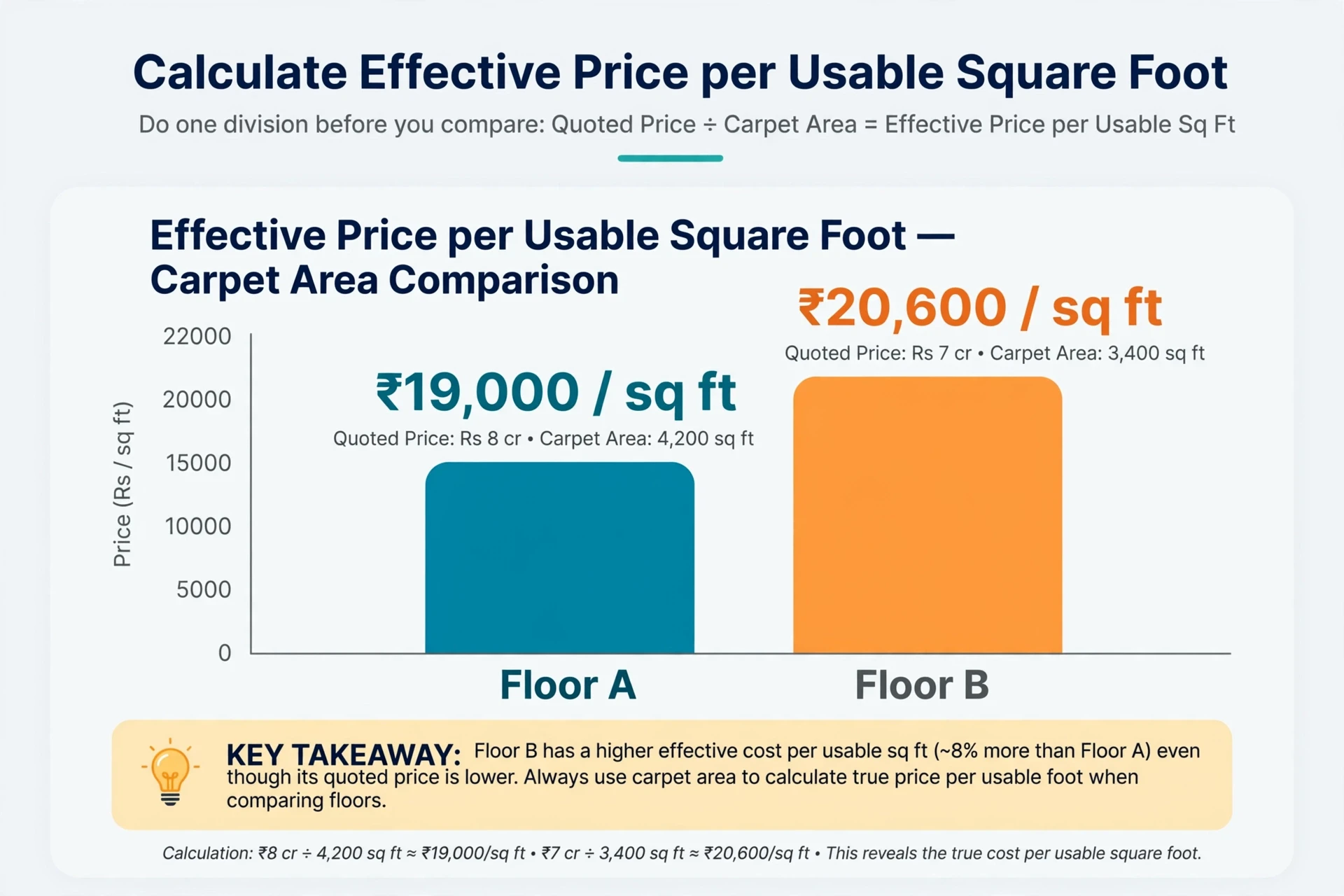
Keep it in a simple table as you shortlist.
| Floor | Quoted Price | Carpet Area | Effective Rs/sq ft |
|---|---|---|---|
| Floor A | Rs 8 cr | 4,200 sq ft | ~19,000 |
| Floor B | Rs 7 cr | 3,400 sq ft | ~20,600 |
Test Parking, Terrace, and Exclusive Areas Separately
Terraces, stilt parking, and basement rights are outside carpet area by law, yet they carry real value. Price them as line items: confirm each is freehold and recorded in the sale deed, not a verbal promise. Learn how RERA carpet area works, and check the Haryana RERA carpet area regulations before you sign.
Step 4: Inspect Structure, Services, and Construction Specification
Paint hides more than it shows. The costly faults in a builder floor sit behind walls, under terrace tiles, and inside the electrical board, so inspect the building, not the styling.
Inspect the Building Envelope and Wet Areas
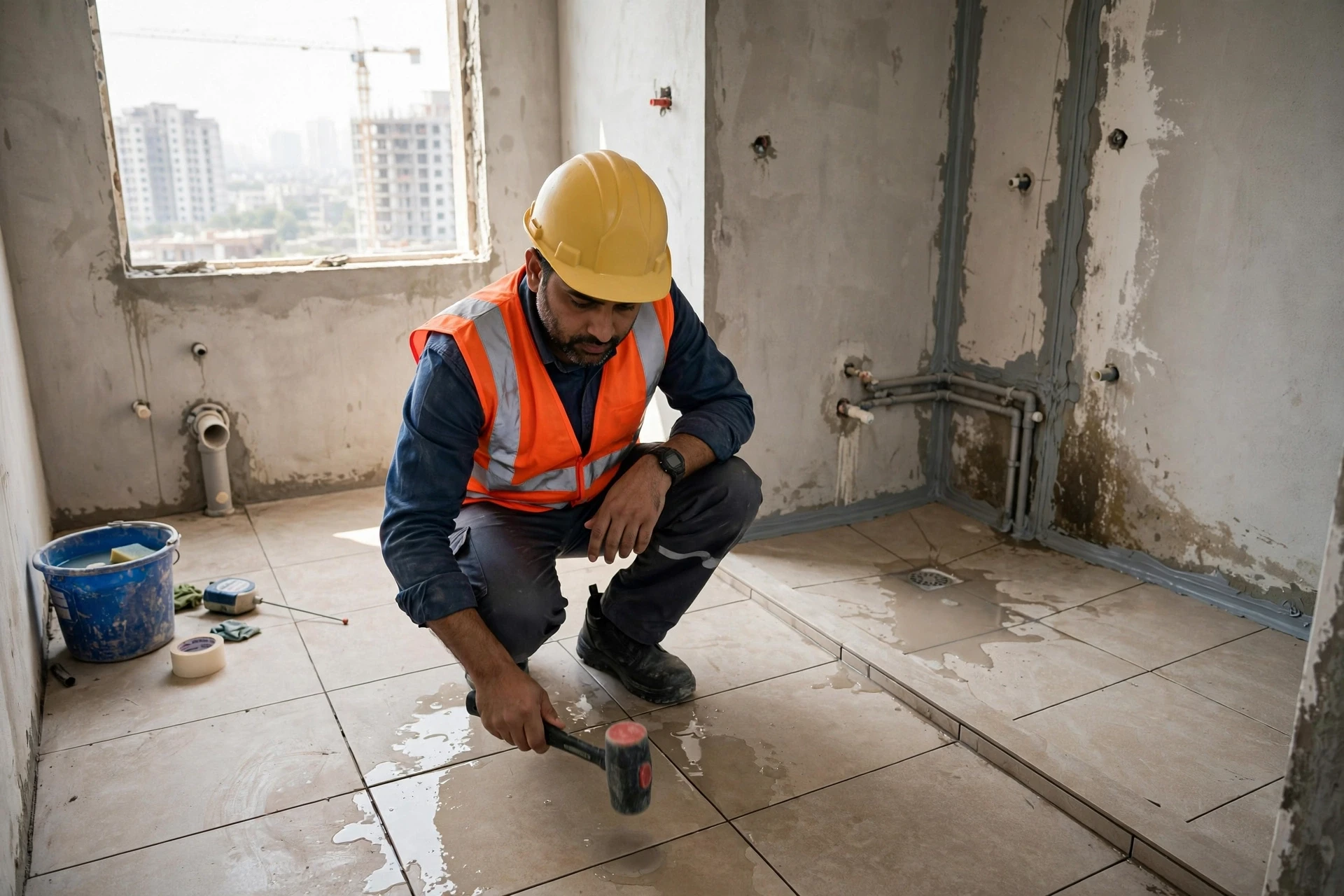
Walk the building before you enter the floor. Look for diagonal cracks near columns and window corners, damp patches on stair ceilings, and terrace doors that actually open. Water is the expensive part: run every tap, flush each toilet, and check that bathroom floors slope toward the drain instead of pooling. Tap tiles for hollowness and check sealant at sinks and showers. Inspectors in Gurgaon routinely find leakage and dampness in new units, not just old ones.
Verify Services and Building Operations
Open the electrical distribution board with the electrician present. It should be neatly wired, labelled, and fitted with proper protective devices. Confirm dedicated points for ACs, geysers, chimney, and purifier, and test water pressure with two outlets running at once. Then check how the building operates: independent meters, tank capacity, pump access, and who controls the staircase and roof. Guidance on checking builder floor quality stresses exactly this – the utility balcony, shaft, and meter area reveal how the building will age.
Compare Specification Against the Written Schedule
Ask for the written specification sheet and match it line by line: concrete grade, tile brand, window system, sanitaryware model. A pre-delivery inspection checklist is the right frame – document every deviation in writing before registration. On our own floors, we invite buyers to verify each spec on site, because quality you can see is the only kind worth selling.
Also Read: Stilt Plus 4 Floor Rule in Gurgaon: What Every Builder Floor Buyer Must Verify
Step 5: Judge the Micro-Market as an Owner, Not Just a Buyer
Most buyers compare corridors on price per sq ft. Owners should compare them on daily life first, and resale second. Gurugram grew about 12% year-on-year in 2025, but that average hides sharp differences between pockets, so the sector matters as much as the corridor, as our own experience across Golf Course Road, Sector 57, and the Dwarka Expressway belt shows.
Compare Established Low-Rise Neighbourhoods
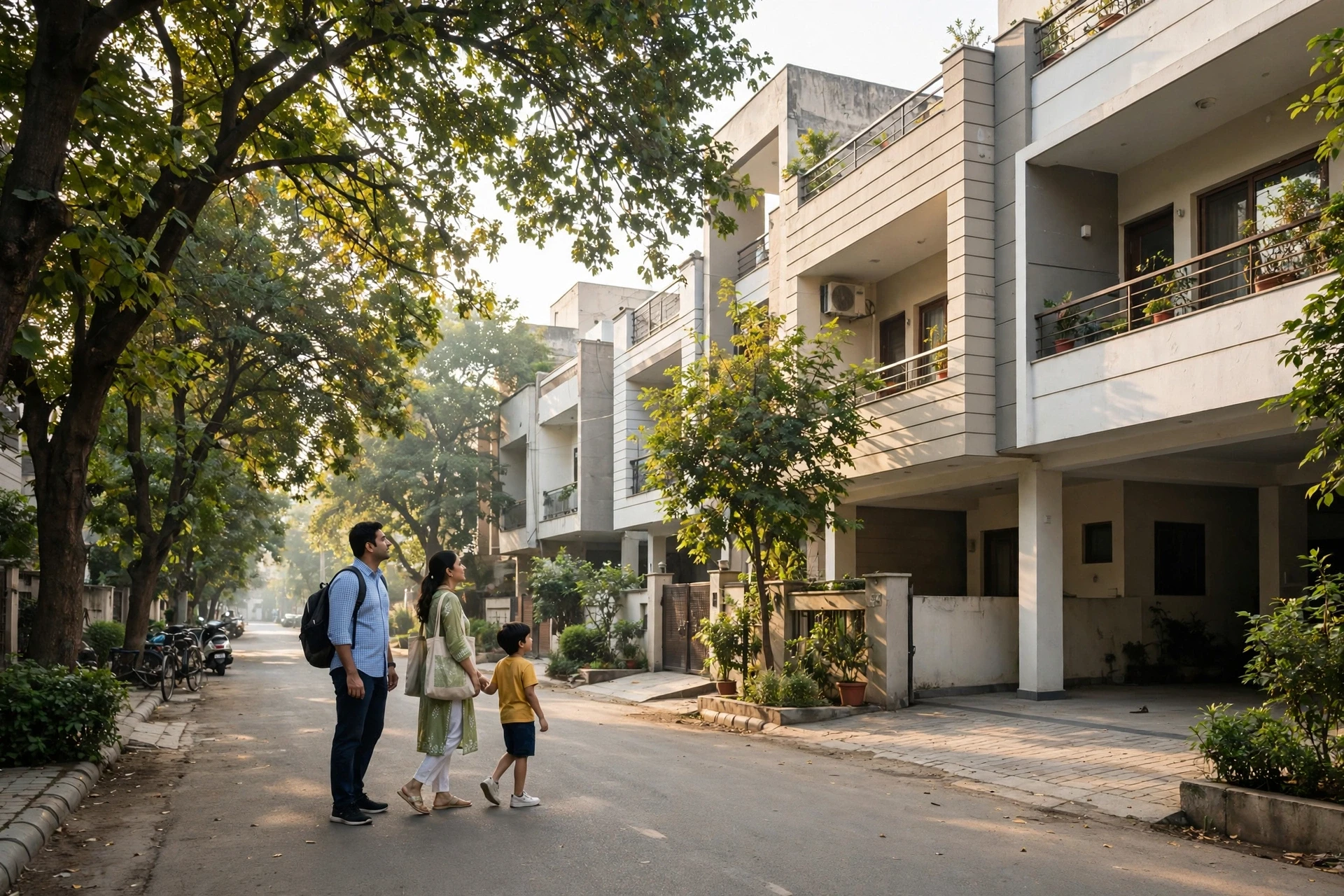
Established pockets like Sushant Lok, South City, Nirvana Country, and parts of Sector 57 give you what a new corridor cannot: working schools, markets, parks, and a settled resident base today. Golf Course Road proper is nearly built out, so most floors there are resale stock trading around ₹18,000-26,000 per sq ft, with demand deep because supply is scarce. On Golf Course Extension Road, the spread within one corridor is huge – Sector 58 printed negative growth while Sector 63 rose up to 20.3% in a year. Neighbourhood-level detail beats corridor averages every time. Visit at 8 am, 6 pm, and 10 pm before you judge.
Test Growth Corridors Against Present-Day Livability
Growth corridors like Dwarka Expressway reward patience, not impatience. The expressway is fully operational and the airport tunnel is open, but service roads and social infrastructure are still filling in. Rental yields there run a thin 2-3%. Ask one question: would your family live well here next month, not in 2030?
Measure Noise, Access, and Resale Liquidity
Stand outside the plot with the engine off. Listen for highway hum, construction, and market traffic – a road-facing floor discounts hard at resale. Check the actual drive to your office, airport, and school at peak hours, not on a map. Then check liquidity in that specific sector, because some sell in weeks while others sit for quarters. A well-located floor with real land share stays the easiest asset to exit.
Also Read: How to Buy Builder Floors in Gurgaon: A Complete Due Diligence Guide
Step 6: Model Ownership Costs, Rental Demand, and Exit Risk
Calculate the Full Cost of Ownership
The purchase price is only part of the number. Start with stamp duty: in Gurugram’s urban areas, a male buyer pays 7%, a female buyer 5%, and joint ownership 6% of the higher of the sale price or the government’s circle rate valuation. Add registration fees, 1-2% brokerage, and legal costs.
Then carry costs. Builder floors win here: upkeep typically runs a fraction of high-rise maintenance, though a private lift and power backup add real service expenses. Budget annually for property tax, insurance, and periodic facade and waterproofing work. On a Rs 5 crore home, these line items are small but not zero.
Run End-Use and Rental Scenarios
Decide what the asset must do. If you live in it, the return is space, privacy, and land share – not yield. If you rent it out, test the numbers honestly. Gurugram’s gross rental yields mostly sit between 2.5% and 4.5%, with corridors near business districts doing better; check area-wise yield data and ask for actual recent rent agreements, not portal averages. Ask who your tenant would be. Floors near Golf Course Road and Cyber City draw senior executives and expats; a fourth-floor unit without a lift narrows that pool.
Assess Resale and Financing Friction
Exit risk lives in liquidity, not price. Two checks matter:
- Buyer pool. Established plots in DLF Phases, Sushant Lok, and Sector 57 resell faster because land value supports the price. Supply-heavy belts on the Dwarka Expressway move slower.
- Loan eligibility. Banks lend more readily on clear-title, approved floors. Verify the sanctioned plan and completion certificate early – friction here costs you buyers later.
A floor with clean papers and strong land share holds value even in a slow market.
Step 7: Resolve Shared Rights and Practical Living Conditions
Put Terrace, Parking, and Access Rights in Writing
In a Gurugram builder floor, the sale deed decides who owns what – not verbal promises. If the deed is silent, the roof and stilt areas are treated as common, and that is where most floor disputes start. Check that your deed recites the land share, the exact parking slot, and any terrace rights, and that the shares across all deeds add up to 100%.
- Terrace: exclusive rights should be registered, with common access kept for water tanks and services
- Parking: ask for the specific stilt slot in writing, not “one car parking”
- Stairs, lift, and entrance stay shared by default
This guide to builder floor ownership in Gurgaon explains what a deed actually conveys.
Agree on Maintenance and Alteration Rules
With no RWA behind you, repairs need consent. Fix who pays for the lift AMC, pump, and structural work, and how the split is calculated. Also check the deed for alteration limits before you plan any change to the facade, terrace, or common walls. A short written co-owner agreement, signed by all four families, costs little and prevents the fights that stall a building for years.
Ask What Ownership Feels Like Day to Day
Visit the building at night and on a weekend morning. Listen for water pump noise, count cars against slots, and meet the neighbours. Three co-owners decide how quiet your home actually is.
Also Read: How to Verify Builder Floor Construction Quality Before Booking
Step 8: Make the Purchase Decision Using a Written Scorecard
Emotion closes deals. Paper should close this one. A written scorecard turns seven loose impressions into one number you can defend.
Score the Asset Across Seven Decision Categories
Rate each category out of 10, with written evidence next to every score. Property disputes dominate civil litigation in India, so weak scores need documents, not assurances. A useful framework comes from property evaluation guides that use a weighted scorecard before any money moves.
| Category | What proves the score |
|---|---|
| Land share and title | Clear 30-year chain, lawyer’s opinion |
| Approvals | Sanctioned plan, RERA, occupancy status |
| Usable area | Measured carpet vs quoted area |
| Construction | Structural spec, waterproofing, finishes |
| Micro-market | Resale depth in the sector |
| Ownership economics | All-in cost, rental yield, exit math |
| Builder conduct | Past delivery, complaint history |
- Total the scores. Anything under 7 average needs a written reason.
- Compare shortlisted floors on the same sheet, never on memory.
Set Conditions Before Signing or Paying
Agree to proceed only if specific conditions clear first: clean title opinion, encumbrance certificate, sanctioned plan match, and bank funding confirmation. Withhold token money until each one lands in writing.
Know When to Decline the Property
Walk away if any hard check fails: broken title chain, missing occupancy certificate, or unexplained price. Property litigation runs 15-20 years on average. No floor is worth that.

If you’d rather walk through a floor’s documents and construction with someone who builds them, talk to us at Homezop. We’ll arrange a private site visit and a candid founder conversation – no pressure, just answers to your specific questions.
Frequently Asked Questions
Q1: Which Gurugram floors offer substantial land ownership?
Independent builder floors in sectors like 57, Golf Course Road and Nirvana Country typically carry significant land share. Ask the seller for the exact square yards allotted per floor before you commit.
Q2: How do I verify a builder floor’s title?
Get the mother deed, sale deed chain and Mutation records checked by a property lawyer. Confirm the plot is freehold with no pending litigation or bank dues.
Q3: Is RERA registration needed for builder floors?
Floors built on plots under 500 square metres, or with fewer than eight units, often fall outside RERA. Verify the specific project’s status on the Haryana RERA portal.
Q4: What should I check about construction quality?
Inspect RCC structure, waterproofing, electrical wiring brands and plumbing. Ask for soil test reports and structural drawings, not just showroom finishes.
Q5: Carpet area or super area: which matters?
Carpet area is what you actually use. Compare quotes on carpet rate, since super area inflates the effective price by 20-30%.
Q6: Are builder floors a good investment in Gurugram?
In proven micro-markets, yes. Land share drives appreciation, and rental yields for quality floors remain steady. Evaluate holding cost against your exit horizon.
Conclusion
A Rs 4-10 crore floor in Gurugram is a land decision wrapped in a construction decision. Check the land share in the deed, the unbroken title chain, DTCP approvals and RERA status, then measure carpet area against what the sanctioned plan allows. Haryana’s Jamabandi record catches most fraud in minutes, and a lawyer-led review of the full document set catches the rest. Micro-market logic and ownership economics settle the final ranking. Do this in order, and the paperwork protects the lifestyle you are buying.



Pingback: 7 Gurgaon Builders for High-End Residential Projects – Homezop Insights
Pingback: Builder Floor Price in Gurgaon 2026: Sector-by-Sector Rates – Gurgaon Insights