

Quick Summary: Gurugram home prices keep climbing despite monsoon flooding, with premium under-construction homes up 2-19% in 2025 and average values up about 150% since 2019, because demand comes from wealthy corporate buyers and scarce land in good sectors. Flooding reprices individual homes, not the whole city, so buyers should check plinth height, drainage, carpet area and land share before paying a premium. Homezop, a Gurugram builder, says it raises finished floor levels and keeps services off the lowest slab on its projects, and it quotes carpet area upfront so buyers can compare like with like.
Gurugram property price resilience held firm in 2025. Savills India, as reported by Hindustan Times, recorded 2-19% year-on-year growth in premium under-construction homes and 5-9% in completed ones, even as waterlogging complaints continued.
Yet resilience at the city level says nothing about one street’s drainage. For a buyer committing Rs 4-10 crore, that gap matters to daily use, insurance and resale. As a Gurugram builder, I wrote this guide to show how to test a specific home’s flood exposure before judging its price.
What do the latest figures say about Gurugram home prices?
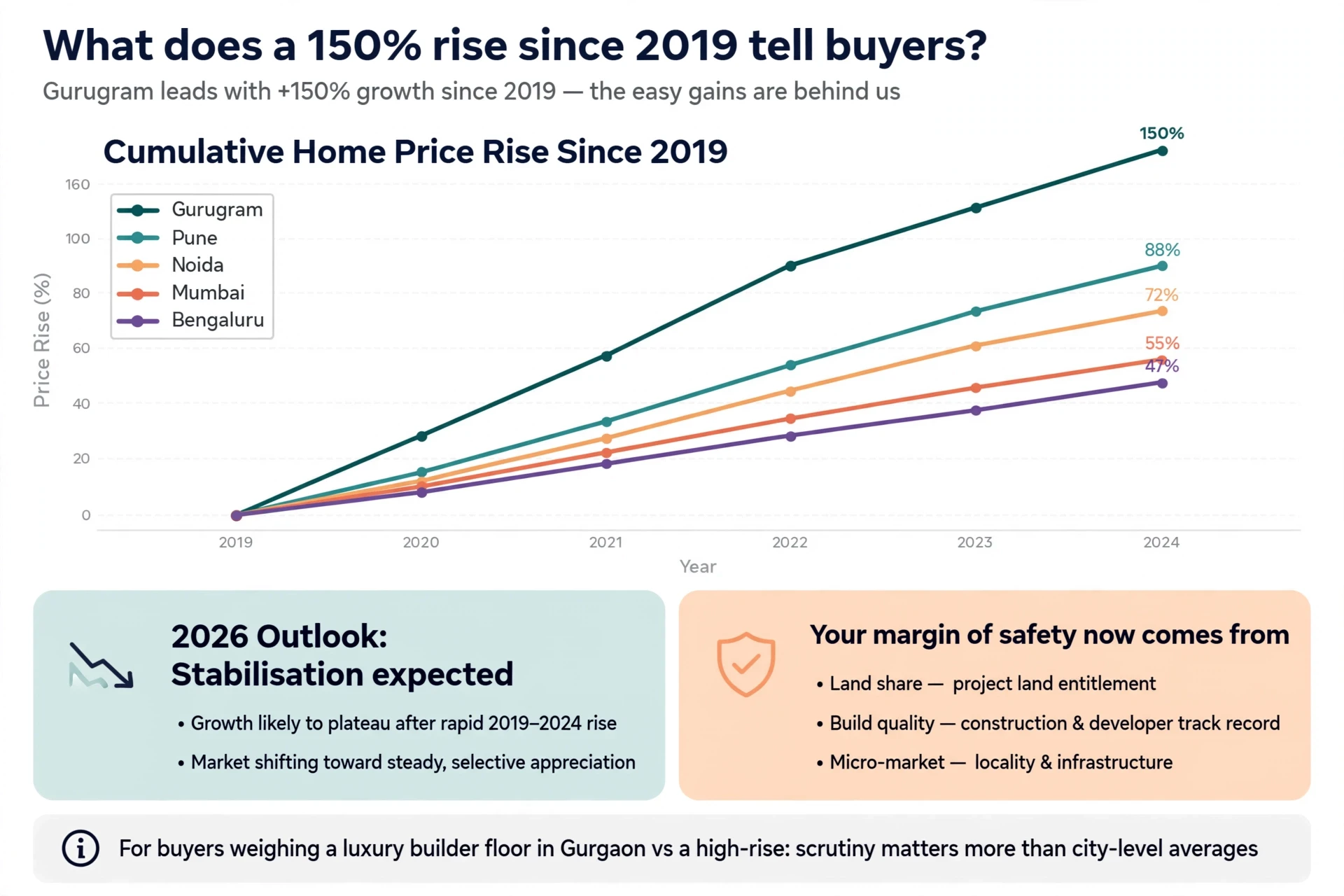
Gurugram recorded the sharpest price rise of any major Indian city since 2019. Average housing values there climbed about 150%, ahead of Pune at 115% and Noida and Greater Noida at 104%, according to Square Yards data reported by Business Today. Demand from premium and luxury buyers drove most of it. That is the core of Gurugram property price resilience: even when monsoon flooding makes headlines, transaction values keep climbing because the buyer base is wealthy and land in good sectors is scarce.
How much did premium prices change in 2025?
Premium under-construction homes in Gurugram rose between 2% and 19% year on year in 2025, per Savills India. Completed premium homes rose a steadier 5-9%. The spread matters. Ready homes in established sectors moved at a measured pace, which suits buyers at the Rs 4-10 crore level far better than the sharper swings in under-construction launches elsewhere.
The rental side adds to the picture. Dwarka Expressway rents grew up to 25% and Golf Course Road up to 20% over the year, which supports yields for owners who hold rather than flip.
Steady growth in ready inventory usually signals end-user demand, not speculation. That is the healthier kind of price rise.
What does a 150% rise since 2019 tell buyers?
It tells you the market absorbed six years of monsoon disruption, infrastructure chaos and price correction fears, and still compounded faster than Pune, Mumbai or Bengaluru. Scarcity of well-located land and rising HNI wealth did the heavy lifting.
It also tells you the easy gains are behind us. Analysts expect 2026 to bring stabilisation, so your margin of safety now comes from what you buy: land share, build quality and micro-market. For buyers weighing a luxury builder floor in Gurgaon against a high-rise, that scrutiny matters more than city-level averages.
Demand holds because Gurugram is the largest private-sector employment hub in NCR, and premium buyers chase ready homes in short supply rather than wait for infrastructure to catch up. That is the core of Gurugram property price resilience.
How do jobs and high-income buyers support housing demand?
Jobs come first. Gurugram hosts hundreds of Fortune 500 offices, global capability centres, IT firms, consultancies and startups across Cyber City, Golf Course Road and Udyog Vihar. Each expansion brings senior professionals, founders and CXOs who need homes within a short drive of work. This is not speculative money; it is end-user demand anchored in payrolls.
The city contributes roughly 70% of Haryana’s annual economic investments, so the pipeline of high-income arrivals keeps refilling according to market overviews. A flooded road is an inconvenience for a week. A 40-minute commute saved every day is worth crores of lifetime value to a busy executive.

Investors add a second layer. Rentals near business districts yield 4-6%, and corporate tenants pay premiums for quality homes. So even when monsoon headlines deter some buyers, the pool of tenant and end-user demand barely shrinks.
Why can premium and ready homes hold demand?
Supply, not sentiment, does the work here. Quality ready homes in established micro-markets are scarce, and buyers have learned to fear under-construction risk. A completed builder floor in Sector 57 or Golf Course Extension trades immediately because it removes execution and delay risk entirely.
Prices tell the story: average rates have climbed from about ₹7,500 per sq ft in 2019 to roughly ₹19,500 by 2024, with premium pockets rising 12-18% a year per market forecasts. Buyers evaluating luxury independent floors in Gurgaon are pricing in land share, construction quality and location, not monsoon news cycles. Resilience here is structural: limited supply, income-backed demand and a preference for assets that are finished.
How does flooding change the value of a specific home?
Flooding does not reprice an entire market. It reprices individual homes, and the discount depends on what water actually touches: the plinth, the parking level, the electricals and the ground-floor layout. Two homes on the same street can carry very different risk.
Which parts of a home’s use can waterlogging disrupt?
Waterlogging attacks function before it touches price. In Gurugram, the failure points are predictable.
- Access and parking. Basements fill first. A car lift or ramp that floods twice a monsoon stops being an amenity.
- Ground-floor living. Water entering a living room or bedroom level forces repairs, drying and, in bad cases, replacement of flooring and woodwork.
- Electrical and plumbing systems. Wiring, DG panels and pumps sitting at or below grade fail first, and repairs take weeks during peak season.
- Daily routine. School runs, office commutes and deliveries all break when internal roads stand under knee-deep water.
[Video: property flood risk explained]
On low-rise floors, the damage usually stops at the stilt. That is why we at Homezop raise finished floor levels, keep services off the lowest slab and specify drainage on every project. Buyers evaluating a builder floor in Gurgaon should ask for plinth height and storm-water drawings before price. Our guide to evaluating Gurugram builder floors lists these checks in detail.
Can flooding affect resale or rental demand?
Yes, but unevenly. A home that stayed dry through a heavy monsoon sells with confidence; one that flooded needs a discount, and buyers will ask for repair records. Rentals behave the same way. Tenants pay a premium for micro-markets like Golf Course Road or Sector 57 that drain well, and walk away from addresses with a known flooding history. Reputation lingers. Resale values recover where the builder documents flood-proofing, because the next buyer can verify it rather than guess.
How should buyers compare Gurugram micro-markets and infrastructure?
A micro-market is judged on the same three things everywhere in Gurugram: how water behaves, how traffic moves, and whether the promised road or metro actually exists. Price tells you what people believe today. Infrastructure tells you whether daily life will work tomorrow.
What should buyers verify on the actual route to a property?
Drive the route yourself, twice: once at rush hour, once during or right after a heavy shower. Brochures measure distance in kilometres. You live it in minutes, and those two numbers rarely match.
Check whether the approach road is a service road, a sector road or a highway ramp. Look at the kerb height, the drain covers and the slope. Gurugram’s terrain drops roughly 78 metres from the Aravalli edge toward the Najafgarh drain, so water collects at predictable low points according to a ministry statement in Parliament. Even the Dwarka Expressway service road has flooded in intense rain, as recent reports noted.
Also time the last stretch: the 500 metres from the main road to the gate. That is where most of the daily friction sits.

How should buyers assess locality claims?
Treat “upcoming metro” and “proposed expressway” as zero until you see work on the ground. Planned corridors have slipped for years across NCR; completed ones, like the Dwarka Expressway, shifted values only after they opened.
Compare categories on facts: distance to the airport, school runs, hospital access, water supply source, and drainage history. Our own comparison of Golf Course Road and newer Gurugram communities shows the trade-off clearly: established sectors offer proven infrastructure at a premium, new corridors offer better prices with execution risk.
Ask for the sector’s waterlogging record. If the seller cannot answer, that is the answer.
What should buyers check before paying a premium?
A premium is only justified when the paperwork, the land share and the construction all hold up. In Gurugram, where a Rs 4-10 crore home is common, the checks below separate a sound purchase from an expensive one.
How can buyers verify title, land share and RERA status?
Start with the title. Ask for the chain of documents for the last 30 years and have a lawyer confirm the seller can transfer clean, marketable title. For a builder floor, confirm the plot is freehold and the sale deed records your undivided share of the land, not just the built structure.
Next, check RERA. Every new project in Haryana must be registered with HRERA Gurugram, and the registration number should appear in the agreement. Look up the project on the Haryana RERA portal to confirm the approval covers the exact floor or unit you are buying, and note the promised possession date.
Also insist on:
- The sanctioned building plan and a completion or occupancy certificate for ready units
- Clearance of dues: property tax, electricity and society charges
- The encumbrance certificate confirming no loan or lien sits on the property
If any of these are missing, the discount you are being offered is the price of the risk.

How should buyers compare area and construction value?
Compare carpet area, not super area. Two floors quoted at the same price can differ by 15-20% in usable space once balconies, walls and common areas are stripped out. Ask for the carpet area in square feet and price the home on that number alone.
Then weigh construction quality. Check the structural design, slab thickness, waterproofing on terraces and basements, and the grade of fittings. A low-rise independent floor with a genuine land share usually holds value better than a high-rise unit of the same size, because you own a share of appreciating land rather than air rights.
When we build at Homezop, we quote carpet area upfront and detail the specification in the agreement, so a buyer can compare like with like. Ask any builder for the same, in writing.
At Rs 4-10 crore, the difference between a fair price and an inflated one is rarely visible on a site visit. It shows up in the documents and the area statement. Verify both before you commit, and ask for a private walkthrough with the founder if you want the spec explained line by line.
What does the evidence say about the next phase of prices?
The official signals point up, not down. Gurugram’s circle rates rose 15-30% for 2026-27, and in about 11% of fast-developing areas they climbed as much as 75%. Circle rates reflect actual registry data, so the government is following real transaction prices, not setting them.
Market trackers tell the same story. City-wide rates in 2026 sit between ₹15,000 and ₹20,000 per sq ft on average, with Golf Course Road, DLF Phases 1-5 and Sohna Road commanding more. Premium and developing areas have seen 15-30% increases. Dwarka Expressway moved from ₹10,000-18,000 to ₹11,000-20,000 per sq ft year over year.
The flood question changes where this growth lands, not whether it happens. Micro-markets with sound drainage and elevation, such as higher ground along Golf Course Road and parts of Sector 57, should hold their premium. Low-lying stretches that flood repeatedly will see buyers demand a discount, and that gap is likely to widen.
| Signal | Reading |
|---|---|
| Circle rate revision 2026-27 | 15-30% up |
| Premium micro-markets | 15-30% price growth |
| Flood-exposed stretches | Growing discount risk |
For buyers at Rs 4-10 crore, resilience now carries a price tag. It is worth paying.
How did Gurugram reach this point?
Gurugram grew faster than its drains. Farmland became offices and towers in about two decades, and prices followed the corporates, not the stormwater network. That gap defines the market today.
The city moved from villages and scrubland to a Fortune 500 hub as Cyber City, Golf Course Road and later the Dwarka Expressway came up. Developers built upmarket stock quicker than the municipal corporation could lay drainage. When rain arrives, Golf Course Road and NH-48 still flood, even in front of the priciest towers, as recent reports on Gurugram’s waterlogging show. In July 2026, the police asked companies to let staff work from home after heavy rain gridlocked the expressway, a pattern that repeats most monsoons.
Prices, meanwhile, kept climbing. Haryana raised collector rates this April, with hikes of 15 to 30 percent across Gurugram and up to 67 percent on Dwarka Expressway sectors. The administration itself flagged 159 waterlogging hotspots for the 2026 monsoon. Demand from corporate tenants and wealthy buyers simply absorbs the infrastructure risk.
For a buyer at Rs 4-10 crore, that history is the whole lesson: micro-location and site-level drainage matter more than the sector’s brand name. We look at how each pocket drains before we look at its floor plate.

If flooding and infrastructure risk make you second-guess where to buy in Gurugram, walk the ground first. At Homezop we build luxury independent floors on elevated, well-drained plots with real land share. Talk to me directly and I will show you exactly how we assess every site.
Frequently Asked Questions
Q1: Why are Gurugram homes retaining demand despite infrastructure problems?
Because demand here follows jobs and income. Gurugram’s corporate base keeps rental and resale demand strong, so buyers price flooding as a known risk and pay for location, land share and build quality instead.
Q2: Which Gurugram micro-markets handle monsoon water best?
Elevated plots on Golf Course Road and planned sectors like 57 drain faster than low-lying stretches near older colonies. Check the plot level against the road, not just the sector name.
Q3: What should I verify before buying a builder floor?
Confirm land share, carpet vs super area, RERA status, the sanctioned layout, and how the builder handles rainwater and sewage lines.
Q4: Does flood risk affect resale value?
It narrows the buyer pool in weak monsoons, but well-built, well-drained floors recover faster and hold a premium.
Q5: Are independent floors safer than high-rises here?
Low-rise floors on elevated freehold plots avoid basement flooding and lift dependency. High-rises carry their own risks in shared basements.
Q6: How do I assess drainage before committing?
Visit after a heavy shower. Look at road water levels, the plinth height and the builder’s stormwater connections.
If you want, walk a site with me after the next rain. I’ll show you what to check.
What Buyers Should Take Away
Flooding has not broken Gurugram’s price logic. Land in the right sectors stays scarce, and demand from buyers like you keeps prices firm. Your job is to price the risk, not the brochure. Check drainage, road levels and past waterlogging before you commit. Compare carpet area, land share and construction spec across builder floors and apartments. A low-rise independent floor in a well-drained micro-market often beats a taller tower on the same budget. The premium survives because location, supply and end-use demand matter more than one bad monsoon. Buyers who verify construction quality at the site, not on paper, pay the right price and hold assets that stay defensible.