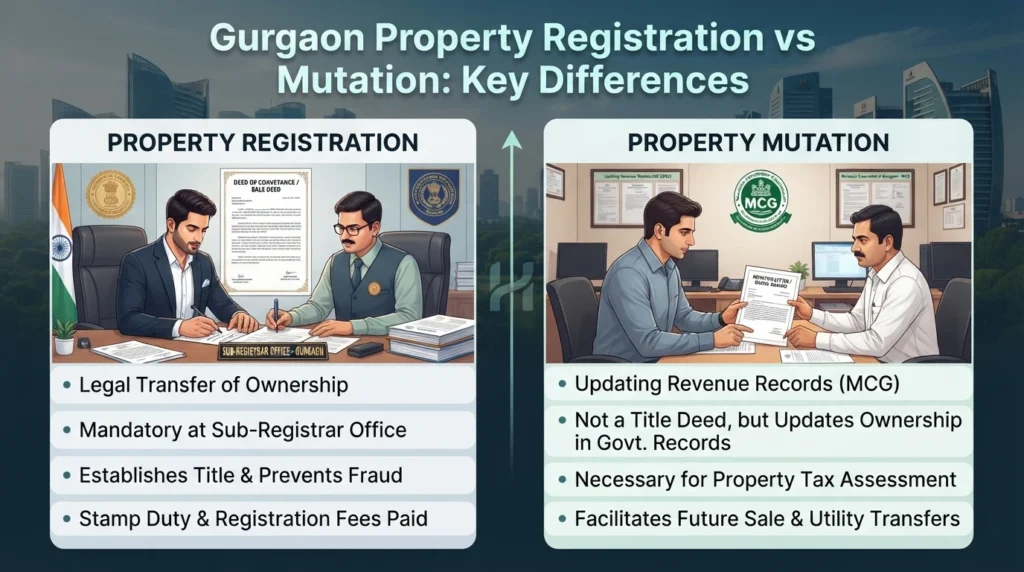

Quick Summary: Property registration and mutation are two separate steps that Gurugram buyers often confuse. Registration at the Sub-Registrar’s office transfers legal title and costs 5-7% stamp duty plus a 1% fee, while mutation updates the revenue record (Jamabandi) and MCG municipal records so property tax, water bills and loan files carry the new owner’s name. Under Haryana’s 2025 Auto Mutation System, eligible cases are processed within about 24 hours of registration, though manual ones still take 30-60 days. Skipping mutation leaves you owning the home on paper but facing stalled resales, tax notices in the seller’s name and home-loan disbursement delays.
At the Sub-Registrar’s office, most buyers treat Gurgaon property registration vs mutation as one step. It is two. Registration transfers legal title to you. Mutation moves your name into the revenue record, so tax bills, water dues and your home-loan file follow the new owner. Miss either and you inherit the seller’s problems.
The pattern is common: an NRI or a time-poor CXO signs the sale deed, pays stamp duty, assumes the deal is closed. Months later, property tax still arrives in the seller’s name, the bank wants a mutation certificate before releasing the final tranche, or the Jamabandi shows the old owner.
This guide separates the two processes, names who does what in Gurugram and Haryana, covers documents, costs and timelines, and explains how the 2025 Auto Mutation System changes the sequence. Register the title, then insist on mutation before possession.
Property Registration vs Mutation in Gurugram: At a Glance
| Property Registration | Mutation (Intekal / Daakhil-Kharij) | |
|---|---|---|
| What it is | Registration of the sale deed (or gift/conveyance deed) before the Sub-Registrar in Gurugram. | An entry in the revenue record (Jamabandi) and the municipal record (MCG) showing the new owner after the sale is registered. |
| Who does it | Sub-Registrar office under the Department of Stamps and Registration. | Patwari countersigned by Tehsildar at the Revenue Department, plus a parallel entry with the Municipal Corporation of Gurugram (MCG). |
| When it happens | On the day of the transaction, before possession is handed over and before mutation can start. | After registration. Under the 2025 Auto Mutation System, eligible cases are mutated automatically within 24 hours; manual mutation still takes 30-60 days. |
| What it costs | Stamp duty (typically 5-7% in Haryana for men, 3-5% for women, depending on circle rate and slab) plus1% registration fee, plus any applicable TDS/fees. | Nominal mutation fee (around Rs 25 to a few hundred rupees at Tehsil level) plus applicable property-tax transfer with MCG. |
| What it proves | Legal title passes to the buyer. This is the document courts rely on in any title dispute. | Confirms to the state and the municipal body that you are the owner for tax, water/sewerage and record purposes. It is not, by itself, proof of title. |
| What happens if you skip it | The transfer is not legally enforceable; a court will treat the previous registered owner as the title holder. | Property tax and water/sewer bills stay in the seller’s name, resale gets harder, home-loan disbursement can stall, and the old name in the Jamabandi invites future disputes. |
How Property Registration and Mutation (Intekal / Daakhil-Kharij) Compare
The core of Gurgaon property registration vs mutation comes down to this: one transfers legal title, the other updates the record. Here is what each one actually is.
Property Registration
Registration is the legal act of recording your purchase before the Sub-Registrar under the Registration Act 1908 and the Indian Stamp Act. It happens on the day of the transaction, and it is the moment title legally passes to you. Skip it and the courts will still treat the seller as the owner.
Key strengths
- Confers enforceable legal title, the document courts rely on in any dispute
- Stamp duty in Haryana typically runs 5-7% for men, 3-5% for women, plus 1% registration fee
Mutation (Intekal / Daakhil-Kharij)
Mutation is the administrative follow-up: updating the Jamabandi revenue record and the MCG municipal record to show your name. Under the 2025 Auto Mutation System, eligible Gurugram cases close within 24 hours; manual ones take 30-60 days. It proves ownership for tax and utility purposes, not title.
Key strengths
- Costs only a nominal fee, around Rs 25 to a few hundred rupees
- Keeps property tax, water and sewer bills in your name, protecting resale and loan eligibility
Why the Two Steps Get Confused in a Gurugram Deal
Most buyers treat registration and mutation as one event. They are not, and the gap matters when crores are on the line.
The legal event vs the administrative update
Registration is the legal act. You sign the sale deed before the Sub-Registrar, pay the stamp duty, and ownership legally shifts to you. That day changes your rights.
Mutation is the bookkeeping that follows. The Municipal Corporation of Gurugram updates its records so property tax bills and civic dues carry your name. It confirms ownership in the government’s books; it does not create it.
The confusion starts because both involve paperwork with your name on it. But one transfers title, the other only records it. Skip mutation and you still own the home, yet every tax notice goes to the seller.
Where the confusion shows up in a Rs 4-10 crore deal
At this price point, delays get expensive. A lagging mutation can stall a later resale, complicate a loan against the property, or muddle an NRI repatriation trail. Buyers focused on closing the deal often discover at exit that the record never moved.
Independent floors add a wrinkle: land share and floor ownership are recorded separately, so both entries need updating. This is one reason we walk Homezop buyers through the full paper trail, not just the registration day, before they commit. The same discipline applies to any Gurgaon property transaction you are weighing.
What Actually Happens at the Gurugram Sub-Registrar
Documents and the day at the Sub-Registrar
Registration is the step that transfers title. Mutation only updates revenue records afterwards, so get this meeting right.
Book the slot on the NREGS/SARAL portal in advance. Both parties appear in person at the Sub-Registrar’s office covering the sector where the property sits. Carry the executed sale deed (usually a printed e-stamp paper), e-stamp receipt, PAN and Aadhaar copies, two passport photos, the latest jamabandi and khasra records for land share, and the property tax clearance. Witnesses: two, with ID proof.
The officer verifies identity, checks the deed against the e-stamp value, photographs the parties and biometrically captures thumbprints. You sign page by page. Within roughly half an hour the deed is registered and scanned; the certified copy arrives online a few days later.
Bring a photocopy set for each document. Missing one restarts the appointment.

Costs in Gurugram: stamp duty, fee and the circle-rate trap
Duty is charged on the higher of the sale price or the collector (circle) rate for that sector. Stamp duty in Gurugram runs 7% for men, 5% for women and 6% for joint male-female ownership.
| Buyer profile | Stamp duty | Registration fee |
|---|---|---|
| Male | 7% | 1% (capped) |
| Female | 5% | 1% (capped) |
| Joint (male + female) | 6% | 1% (capped) |
The trap: on a Rs 6 crore independent floor in an established sector like 57, circle rates can exceed your negotiated price. You then pay duty on the higher figure, roughly Rs 42 lakh, not on what you actually paid. Check the sector’s prevailing circle rate before you fix the price split between land share and construction.
How Gurugram Updates the Record After You Buy
The two-track mutation in Gurugram: revenue record and MCG record
Registration transfers the title. It does not update every record that matters. In Gurugram, mutation runs on two separate tracks, and a careful buyer checks both.
The first track is the revenue record, the jamabandi maintained by the Haryana Revenue Department. This shows who owns the land, the share of each owner, and any charge or entry against it. For an independent floor with undivided land share, your name should appear against the khasra or khewat holding. This record matters most when you sell, because the next buyer’s lawyer reads it first.
The second track is the civic record held by the Municipal Corporation of Gurugram, the MCG. This covers property tax, water and building records. A stale MCG entry means tax bills and dues stay in the seller’s name, and the mismatch surfaces later as a nuisance during resale or resale financing.
Both records should reflect you, ideally within weeks of the sale deed.

The 2025 Haryana Auto Mutation System
This used to be slow. The buyer filed a separate mutation application at the tehsil, attached the sale deed, and waited while the patwari verified the entry. Months were common.
Haryana has changed that. Under the Auto Mutation System, a mutation number is generated at the time of registration itself, and eligible cases are processed automatically without a fresh application, as reported by ET Realty. The state’s stated aim is a paperless registry completed within about 24 hours. Cases that need partition, or carry disputes, stay outside the automatic route.
Two cautions. First, auto mutation covers the revenue record; the MCG civic record still needs its own transfer. Second, verify the entry online after closing. At Homezop we hand buyers the mutation number and the record links, so the file closes clean. For transfer of an inherited or gifted property, the NRI guide covers the additional steps.
What Each Step Actually Proves (and What It Does Not)
Registration proves the transfer happened. The sub-registrar recorded the sale deed, you paid stamp duty, and the title passed to you on that date. That is the legal fact.
What it does not prove is that the government’s day-to-day records agree with you. The revenue record (jamabandi) and the MCG’s property tax register still carry the seller’s name. Until those change, every utility bill, tax notice and bank query treats you as a stranger to your own home.
Mutation closes that gap. It updates the civic and revenue records in your name, which proves possession for practical purposes: you can pay property tax, sell later, or raise a loan without friction. It does not, by itself, cure a defective title. If the sale deed had a flaw, mutation will not fix it.
So the two steps answer different questions. Registration answers “do you own it?” Mutation answers “does the system know you own it?” A Rs 8 crore Gurugram floor with only the first answer is legally yours but operationally tangled. We ask for both before we call any deal clean, and we walk buyers through the sequence in our Gurgaon property buying guide.

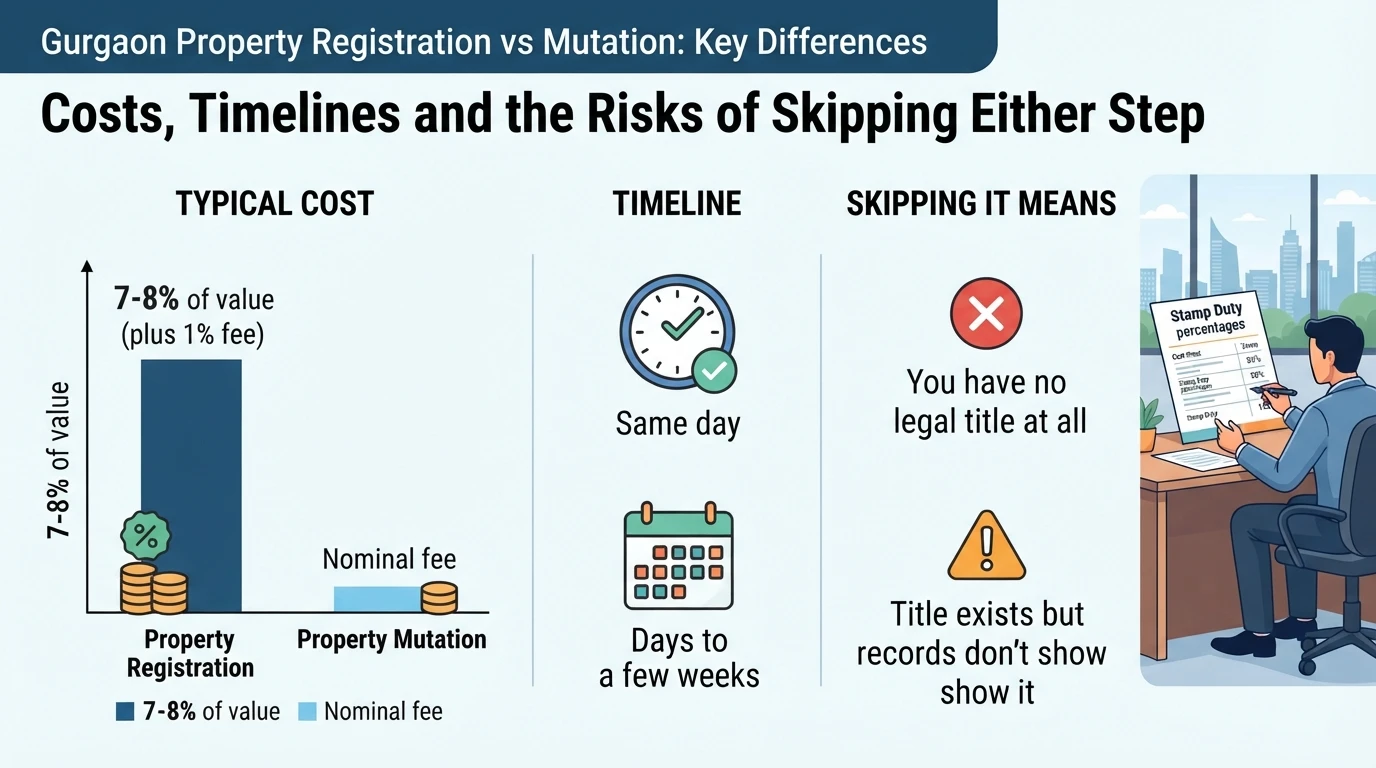
Costs, Timelines and the Risks of Skipping Either Step
Registration is the expensive step. In urban Haryana, stamp duty runs 7% for male buyers, 5% for women and 6% for joint ownership, and the registration fee adds 1% of the transaction value, capped at Rs 50,000. On a Rs 6 crore independent floor, expect roughly Rs 42-48 lakh before you leave the sub-registrar’s office, depending on the applicable rate. Registration itself is same-day if your documents are in order, though popular tehsils like Gurgaon’s Sector 34 office often need a prior appointment slot booked online.
Mutation costs almost nothing. The application fee is nominal, and under Gurugram’s Auto Mutation System, transfer of records can happen within days of registration without a separate application at all.
The asymmetry is the trap. Because mutation is cheap and slow, buyers treat it as optional paperwork. It is not.
| Registration | Mutation | |
|---|---|---|
| Typical cost | 7-8% of value plus 1% fee | Nominal fee |
| Timeline | Same day | Days to a few weeks |
| Skipping it means | You have no legal title at all | Title exists but records don’t show it |
Skip registration and you own nothing. Skip mutation and you own the property but cannot pay property tax correctly, and a future resale will stall until records are fixed. On a multi-crore asset, that delay is a negotiation disadvantage.
A Buyer’s Checklist for the Registration-to-Mutation Handover in Gurugram
Registration gets you the sale deed. Mutation gets the record updated in your name. Both matter, and the gap between them is where buyers slip.
Before registration:
- Verify the title chain and encumbrance certificate covering at least 13 years.
- Confirm stamp duty (7% for men, 5% for women in Haryana) and the 1% registration fee are budgeted.
- Check the seller’s dues: property tax, maintenance, electricity.
- For a builder floor, confirm the land share is named in the deed.
At registration:
- Book a slot on the Jamabandi portal and carry originals plus two witnesses.
- Collect the registered deed the same day or as advised by the Sub-Registrar.
After registration:
- Apply for mutation within 30 days through the Haryana municipal or revenue portal.
- Track the Auto Mutation System update, then verify your name on the Jamabandi record.
- Update electricity, water and society records to match.
Keep certified copies of the deed and mutation order. Lenders and resale buyers ask for both.
If you are weighing an independent floor against an apartment, our guide to builder floors in Gurgaon covers the title and land-share angles in more depth.
Which Should You Prioritise, and When Does the Order Matter?
Prioritise registration. It is the act that transfers ownership. Until the sale deed is registered at the Sub-Registrar’s office, mutation cannot even begin, so the order is fixed: register first, mutate second.
Mutation then matters most for money and records. It updates the municipal register, records your name for property tax, and enables utilities and resale paperwork. Skip it and you still own the home; you just carry avoidable friction into every future transaction.
Two cases where the order bites:
- Resale within a few years. A buyer’s lawyer will ask for the mutated record. If your name is missing, the deal stalls while you fix it.
- Inherited or GPA-linked property. Here mutation can precede a sale deed, and the gaps are where title risks hide. We flag these in our note on GPA property deals in Gurgaon.
Bottom line: registration protects your ownership; mutation protects your convenience and resale speed. Do both, in that order, within the same month if possible.

If you are buying in Gurugram and want the registration and mutation steps handled without guesswork, talk to us. Homezop builds luxury independent floors with clean title and clear land share. A private site visit or a direct word with the founder is all it takes.
Frequently Asked Questions
Q1: What is the difference between property registration and mutation in Gurgaon?
Registration transfers legal title at the sub-registrar’s office. Mutation updates municipal records so property tax and civic dues are billed to you. Registration proves ownership; mutation reflects it.
Q2: Is mutation mandatory after registration?
Not legally required to own the property, but skip it and tax notices, resale and loan processes get messy.
Q3: How long does mutation take in Gurugram?
Through the Auto Mutation System, typically 15 to 30 days after registration, provided dues are clear.
Q4: What documents are needed for mutation?
Registry copy, tax receipts, identity proof and the application fee. It is online now.
Q5: Can I sell without mutation?
You hold clear title, but buyers and banks usually insist on mutated records first.
Conclusion
Registration and mutation answer two different questions. Registration proves you bought the property; mutation records that you own it in the revenue books. In Gurgaon, the first happens at the sub-registrar’s office within months of the sale deed. The second, often through the 2025 Auto Mutation System, updates DHLR records and matters for mutation certificates, water and power connections, and any future resale. For a Rs 4-10 crore independent floor, skip neither step. Verify land share and title before registration, then confirm the mutation entry appears correctly afterward. Buyers weighing an NRI purchase or a first Gurugram floor can review our Gurgaon property buying guide for the full transaction picture.