
Quick Summary: Before paying token money for any Haryana property, especially in Gurugram, verify the Jamabandi record on the official portal against the exact village, khasra, and owner name, as a registry copy alone doesn’t prove title. The article walks through checking mutation status, reading a nakal, and reconciling it with the sale deed, site plan, and encumbrance search, pausing if any mismatch appears. It stresses that Jamabandi is a revenue record, not a substitute for a registered deed, and recommends building a dated file of all documents and getting a lawyer’s review before committing funds.
Before paying token money for a builder floor in Sector 57, a Sohna farmhouse, or land linked to a Gurugram project, check the latest Jamabandi Haryana record against the exact village, khasra number, and owner name. A mismatch in share, cultivator, mutation, or land-use entry can limit what the seller can transfer.
The problem is simple: many buyers treat a registry copy as full proof of title. It is not. Jamabandi Haryana helps you test the current revenue record, but it must match the registry, mutation trail, and on-ground facts.
I build in Gurugram, where land history often sits beneath even a polished independent-floor transaction. This guide shows how to search Jamabandi Haryana, read a nakal, check mutation status, and spot the records that need legal review before funds move.
Step 1: Open the Official Haryana Jamabandi Portal and Identify the Correct Record
Use the Revenue Location, Not Just the Marketing Address
Start at the official Haryana Jamabandi portal, not a property listing or a third-party record app. The portal lets you view Jamabandi and sanctioned mutation details using an owner name, khewat number, or khasra number.
For a Gurugram property, the address on a brochure may say Golf Course Road, Sector 57, or Nirvana Country. The revenue record is filed differently. You need the exact:
- District – Gurugram
- Tehsil – such as Gurugram, Badshahpur, Sohna, Pataudi, or Farrukhnagar
- Village or revenue estate – the recorded village name
- Record period – select the relevant Jamabandi year

Use the WEB-HALRIS record search only after you have this location data. Ask the seller for the registry copy, prior Jamabandi nakal, and khasra details before searching.
| Sales description | What the portal needs |
|---|---|
| Sector or colony name | Revenue village |
| Builder floor address | Khasra or khewat reference |
| Pin code | District and tehsil |
| Plot number | Exact ownership record |
A sector address can cover land from more than one revenue estate. A result that looks close is not enough. Match the land area, khasra numbers, and owner names before treating it as the seller’s record.
Also Read: 2026
Step 2: Search Jamabandi by Owner Name, Khewat, Khatauni, or Khasra
Search by Owner Name
Choose Owner Name if you have the seller’s name but no land reference details. Select the correct district, tehsil, village, and record period first. The Haryana portal allows searches using an owner name, khewat number, or khasra number through its official Jamabandi service.
Type the name as it appears on the seller’s deed or earlier Jamabandi. Try common spelling variants if the result is blank. Check every matching record, not only the first one.
Confirm these points:
- The seller’s full name and parentage
- Their share in the holding
- Co-owners, if any
- Land type and area
- Any remarks against the entry
An owner-name result is only a starting point. Similar names are common in Gurugram villages, so match the land details to the sale deed.
Search by Khewat, Khatauni, and Khasra
Use land numbers when you need a tighter match. Khewat identifies the ownership holding. Khatauni links cultivators or possession entries. A khasra number identifies a specific field or parcel.
| Search key | What it helps confirm |
|---|---|
| Khewat number | Ownership group and each owner’s share |
| Khatauni number | Possession or cultivation record |
| Khasra number | Exact parcel within the revenue estate |
- Copy the number directly from the deed, mutation, or prior Jamabandi.
- Search it against the correct village and period.
- Compare the area, ownership share, and khasra details with the transaction papers.
The portal states that online records use real-time data and cover Haryana’s tehsils through WebHALRIS record access.
For a Gurgaon or Gurugram floor purchase, ask for the parent land’s khewat and khasra references. A unit address alone cannot prove the seller’s land title.
Also Read: 7 Luxury Floor Alternatives To Bptp Amstoria Gurgaon For Families
Step 3: Read a Haryana Jamabandi Nakal Without Misreading Ownership
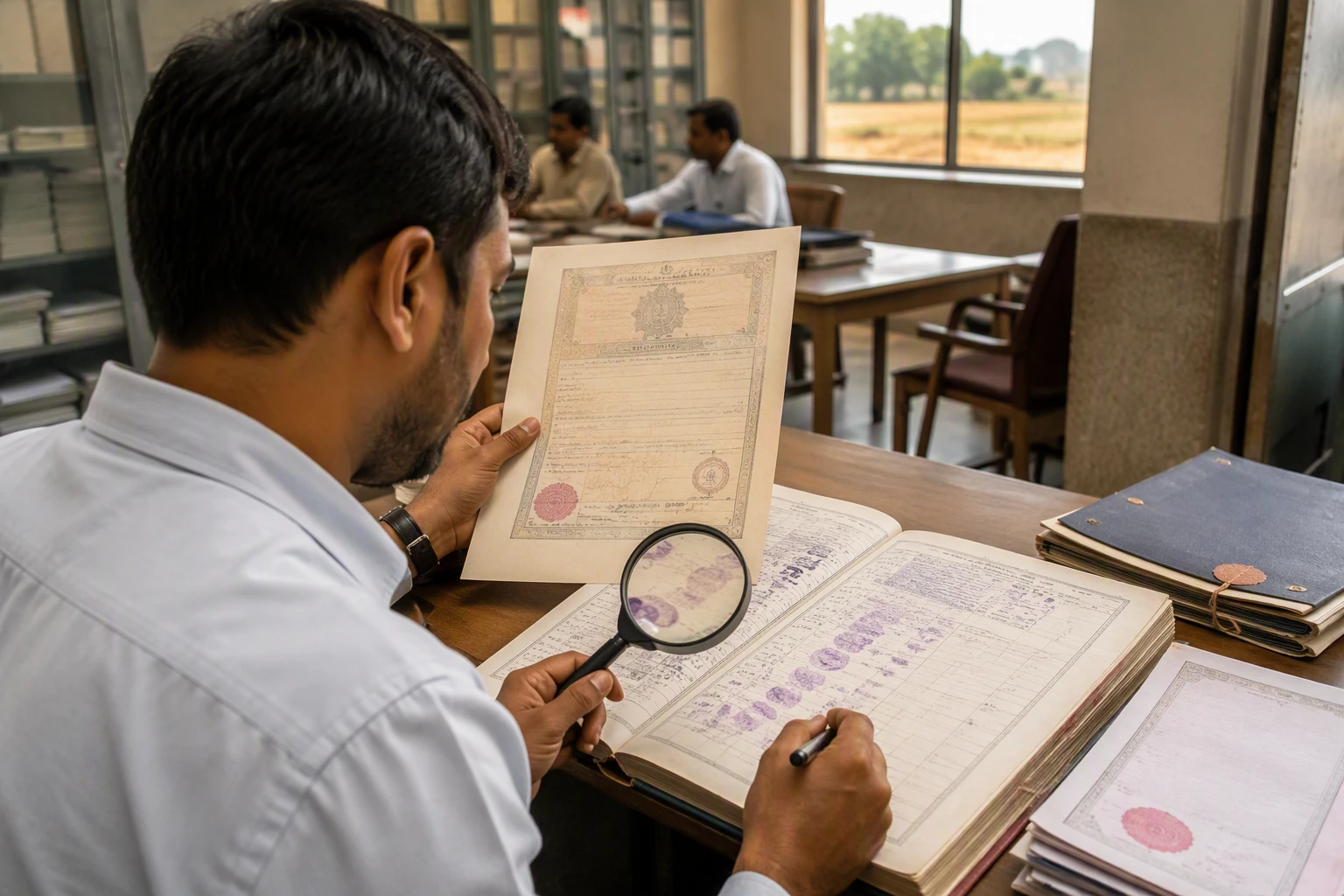
A Jamabandi nakal is a revenue record, not a clean title certificate. Haryana’s official portal says it records ownership, cultivation, and land rights, and is revised on a five-year cycle. Read it against the sale deed, mutation trail, and site plan before relying on it. The official Jamabandi portal also lets you search by owner, khewat, or khasra number.
Khewat, Khatauni, Khasra, and Share
Start by matching these numbers with the seller’s documents:
| Field | What it identifies | Buyer check |
|---|---|---|
| Khewat | Ownership account or group of owners | Confirm every recorded owner has signed |
| Khatauni | Cultivation or possession account | Check who is shown in possession |
| Khasra | A specific survey parcel | Match it to the sanctioned site plan |
| Share | Each owner’s fraction in the land | Ensure the seller can convey the stated share |
A seller may own only a fraction of a larger khewat. That does not automatically give them a defined physical plot.
For a Gurgaon or Gurugram builder floor, do not treat a flat number as proof of land ownership. Confirm the undivided land share in the registered deed.
Owner, Cultivator, Land Class, and Remarks
Read the owner column first. Names, parentage, and shares must match the chain of sale deeds. Then check the cultivator column. A different cultivator can signal tenancy, a licence arrangement, or simply old revenue data. Ask why it differs.
| Nakal entry | What it may reveal | Action before token payment |
|---|---|---|
| Owner name differs | Pending inheritance, sale, or record error | Pause and seek corrected mutation proof |
| Land class | Agricultural, residential, or another recorded use | Check land-use approvals separately |
| Remarks column | Mortgage, court note, acquisition, or other rights | Obtain lender release and legal review |
A mutation updates the revenue record after a transfer. It does not replace the registered conveyance deed. Haryana’s own registration checklist accepts Jamabandi or mutation as ownership evidence, but also requires the deed process and supporting papers. Review the official deed checklist before paying token money.
Step 4: Verify Mutation Status and Trace the Ownership Change
Search and Read the Mutation Entry
A sale deed may be registered, yet the revenue record can still show the prior owner. Check the Mutation Register on the official Haryana Jamabandi portal before you pay token money.
- Select the same district, tehsil, village, and period used for the Jamabandi search.
- Search by the owner name, khewat number, or khasra number.
- Open the mutation entry and match the buyer, seller, land share, and parcel details with the sale deed.
- Check whether the mutation is sanctioned, pending, rejected, or linked to inheritance, sale, gift, court order, or partition.

The portal states that mutation records capture changes proposed in ownership and title, including old and revised khewat details. A sanctioned mutation is useful evidence of revenue-record updating, but it does not replace title review or the registered conveyance deed.
| Check | What should match | Red flag |
|---|---|---|
| Transfer basis | Sale, inheritance, gift, or partition | No clear basis for transfer |
| Parties | Seller and buyer names | Different spelling or missing co-owner |
| Land detail | Khasra, khewat, area, share | Area or share does not match deed |
| Status | Sanctioned entry | Pending, rejected, or disputed entry |
For a Gurgaon or Gurugram builder-floor purchase, trace at least one prior ownership change. Ask for the parent deed, current deed, mutation order, and a fresh Jamabandi nakal. A clean mutation trail reduces risk, but a property lawyer should still check liens, court claims, and authority approvals.
Also Read: 08
Step 5: Check Encumbrances, Court Issues, Acquisition, and Land-Use Restrictions
Check Registered Transactions and Encumbrances Separately
A clean Jamabandi does not prove the land is free from debt, claims, or prior deals. It records revenue entries, not every registered burden.
Ask your lawyer to search the Sub-Registrar’s records for the full title period. Match each entry to the seller’s deed chain and the exact khasra numbers.
| Check | What it may reveal | What to obtain |
|---|---|---|
| Registered sale deeds | Breaks in title or prior transfers | Certified copies |
| Mortgage or charge | Bank or lender claim | Release deed or bank NOC |
| Gift, lease, or power of attorney | Rights held by another party | Supporting registered document |
| Court restraint | Limits on sale or transfer | Current case status |

Do not release token money against a verbal assurance that a loan is closed. Insist on a registered release where needed, plus the lender’s written NOC.
Haryana’s own lending guidance treats Jamabandi and mutation records as loan-file documents, which shows why land records alone are not a complete charge search. See the Haryana cooperative bank loan policy.
Check Planning, Acquisition, and Litigation Indicators
Verify the plot’s permitted use with the planning authority. A residential address does not confirm that each parcel is approved for residential construction.
Before you pay, check:
- Master-plan and zoning status for the khasra or plotted colony.
- Acquisition notices affecting the land or access road.
- Court cases involving the seller, prior owners, or the khasra numbers.
- Building-plan approval and occupation documents for a completed independent floor.
For Gurgaon and Gurugram, also confirm road width, approach, setbacks, and whether any part of the site falls in a controlled area.
A disputed access route can reduce use and resale value even where the home itself has clear ownership.
Step 6: Understand Why Jamabandi Is Not the Registry
Compare the Four Documents in One Transaction
A Jamabandi shows the revenue record. It is useful, but it does not replace the registered sale deed. Treat each document as one part of the ownership file.
| Document | What it tells you | What it cannot prove alone |
|---|---|---|
| Jamabandi nakal | Recorded owner, land share, khasra details, cultivation or possession entry | A valid transfer to the current buyer |
| Registered sale deed | The legal transfer, parties, price, property description and registration | Whether revenue records were updated after registration |
| Mutation | That the revenue record reflects a sale, inheritance, gift or court order | Clear title or absence of prior claims |
| Encumbrance search | Registered charges, mortgages or dealings found in the search period | Unregistered disputes, possession issues or planning breaches |
The Haryana registration checklist itself treats a Fard of Jamabandi as proof of ownership support, alongside an old sale deed or mutation. That distinction matters. The official checklist does not make Jamabandi a substitute for the registered deed.
Before token money in Gurugram, match the sale deed’s plot number, khasra number, area, owner names and boundaries against Jamabandi. Then confirm the latest mutation entry.
A clean Jamabandi can still sit beside an unregistered agreement, a prior mortgage, or a boundary mismatch. Ask for the registry chain, mutation order and lender release papers before you commit.
Step 7: Complete the Gurugram Token-Money Checklist
Documents to Reconcile Before Payment
Do not pay token money until every document points to the same property, seller, and ownership share.
| Check | What must match | Why it matters |
|---|---|---|
| Jamabandi nakal | Khewat, khata, khasra numbers and owner names | Confirms the recorded landholding |
| Registered sale deed | Seller, area, boundaries and chain of title | Shows how ownership was acquired |
| Mutation record | Latest transfer in seller’s name | Flags an incomplete revenue update |
| Site plan and layout | Floor, plot, access and built area | Avoids a mismatch with the unit offered |
| Encumbrance search | Mortgage, charge, court restraint or lien | Protects against hidden lender claims |
The Haryana registration checklist calls for proof of ownership, property map details, identity records, and other papers depending on the transaction type. Review the official deed-registration checklist before signing.
For a builder floor in Gurgaon or Gurugram, also match the undivided land share, sanctioned plan, completion papers where applicable, and any power of attorney.
Put the token terms in writing: refundable triggers, due-diligence period, final price, possession status, and who bears outstanding dues.
When to Pause the Transaction
Pause if the Jamabandi owner differs from the sale-deed seller, or if a mutation remains pending. Do the same where khasra numbers, plot boundaries, or land share do not reconcile.
Stop and get a property lawyer to review the file if:
- A bank loan appears but no closure letter is produced.
- A GPA is used without clear authority and verification.
- Access relies on an unrecorded private passage.
- The seller resists sharing originals or certified copies.
- The floor shown differs from the approved plan.
Jamabandi is a revenue record, not a substitute for a registered title document. Treat it as one checkpoint in a full title review.
Also Read: Blog
Step 8: Resolve Mismatches and Build a Defensible Property File
Document the Issue Before Asking for a Fix
Do not accept a verbal assurance when the Jamabandi, mutation entry, site plan, and sale deed differ. Record the mismatch first, then ask the seller to cure it.
Build one dated file with:
- Jamabandi nakal and mutation status printouts
- Registered sale deed chain
- Khasra and khewat details
- Approved plan, occupation records where relevant, and tax receipts
- A note listing each variance, its source, and the required correction
Check whether names, father or spouse names, share percentages, land area, khasra numbers, and village details match across every record. For an independent floor in Gurugram, also match the land share stated in the deed with the sanctioned layout and the floor being sold.
Haryana’s own deed registration checklist treats proof of ownership, mutation, map plan, and required NOCs as separate checks. One document does not replace another.
Do not pay token money until a lawyer confirms that every material mismatch is either corrected in official records or covered by a clear, enforceable condition in the agreement to sell.

Before you pay token money, review the land record, registry trail, mutation status, and your share in the plot. Homezop can walk you through the ownership structure of its Gurugram independent floors during a private site visit or direct founder conversation.
Frequently Asked Questions
Q1: How to check Jamabandi land records online in Haryana?
Choose district, tehsil, village, then search by owner, khewat, khasra, or khata number. Match every field with the sale deed.
Q2: What is the official website to check Jamabandi in Haryana?
Use Haryana’s official Jamabandi portal. Treat its record as a verification tool, not proof that title is clear.
Q3: How to download Jamabandi Nakal by owner name in Haryana?
Select the owner-name search option and enter the name carefully. Check parentage, share, village, and holding number before saving the nakal.
Q4: What is the difference between khewat, khatauni, and khasra?
Khewat identifies joint ownership, khatauni lists cultivation or possession entries, and khasra identifies a specific land parcel.
Q5: How to check mutation status online in Haryana?
Search the mutation register using the relevant village and mutation details. Confirm that the change follows the registered transfer.
Q6: Is the online Jamabandi Nakal legally valid for property transactions?
No. It supports due diligence but does not replace the registered sale deed, chain documents, or legal title review.
Q7: How to check Jamabandi land records for Gurugram properties?
Select Gurugram district and confirm the correct tehsil and village. Verify land use, ownership share, mutation, and any acquisition history.
Q8: What details are included in a Haryana Jamabandi record?
It shows owners, their shares, khasra numbers, land area, cultivation details, mutations, and recorded rights or liabilities.
Conclusion
Treat Jamabandi as the first ownership check, not the final proof of title. Match the seller’s name, share, khewat, khasra numbers, land area, and possession details. Then review the latest mutation, registered sale deed, court records, maps, and any loan or planning restrictions.
For a Gurgaon or Gurugram purchase, confirm that the land record matches the exact unit, plot, or licensed colony you are buying. A builder floor also needs clear land title, approved plans, and a clean chain of deeds.
Haryana’s WEB-HALRIS system links deed registration, Jamabandi, mutation, and related records. Use that link as a cross-check, not a shortcut around legal due diligence.