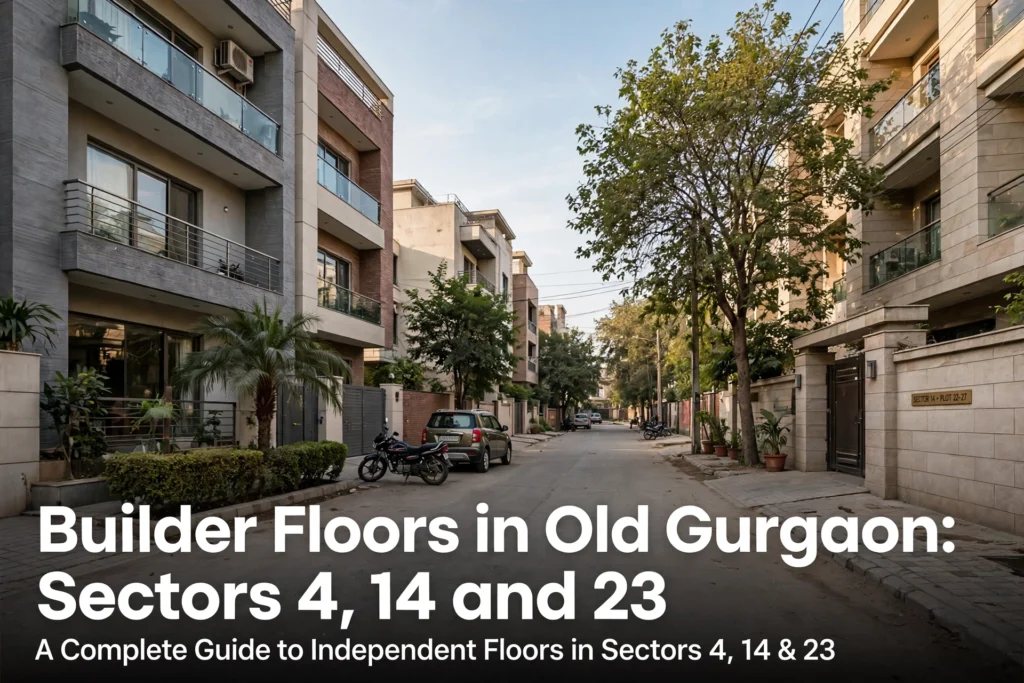

Quick Summary: Two builder floors on similar plots in Old Gurgaon can perform very differently, so buyers should judge the lane rather than the sector name. Sector 14 suits walkable access to Sadar Bazar and the old market, Sector 4 offers the oldest, most central lanes, and Sector 23 gives quieter streets and more open space at some cost to metro access. Before committing, verify title and licence on the exact plot, test summer water and power between 2 and 4 pm, and compare carpet area rather than super area.
Two floors on similar plots in Old Gurgaon can behave very differently. One has room for two cars and steady summer water. The other, a street away, does not. A sector name alone will not tell you which builder floor in Sector 23 Gurgaon, or which builder floor in Sector 14 Gurgaon or Sector 4, actually works day to day. We build floors here, so this guide walks each sector: plot sizes, lane widths, water and power, registry checks. Whether you want a builder floor in Sector 4 Gurgaon or a house for sale in Gurgaon Sector 23, judge the lane, not the label. Old Gurgaon property rewards that habit.
How do Sectors 4, 14 and 23 differ as places to live?
Who is each sector likely to suit?
Sector 14 sits closest to the old city market and the bus stand, so it suits families who want walkable daily life over quiet. Sector 4 carries a strong institutional presence; buyers who value established neighbourhoods over new retail tend to look here. A builder floor in Sector 23 Gurgaon typically suits those who want more open sky and lighter traffic, at some cost to metro access [VERIFY: current metro proximity and internal road widths]. The price ladder across the three sectors [VERIFY: current per-square-yard rates].
What does an older-sector lane feel like compared with DLF Phases or Sushant Lok?
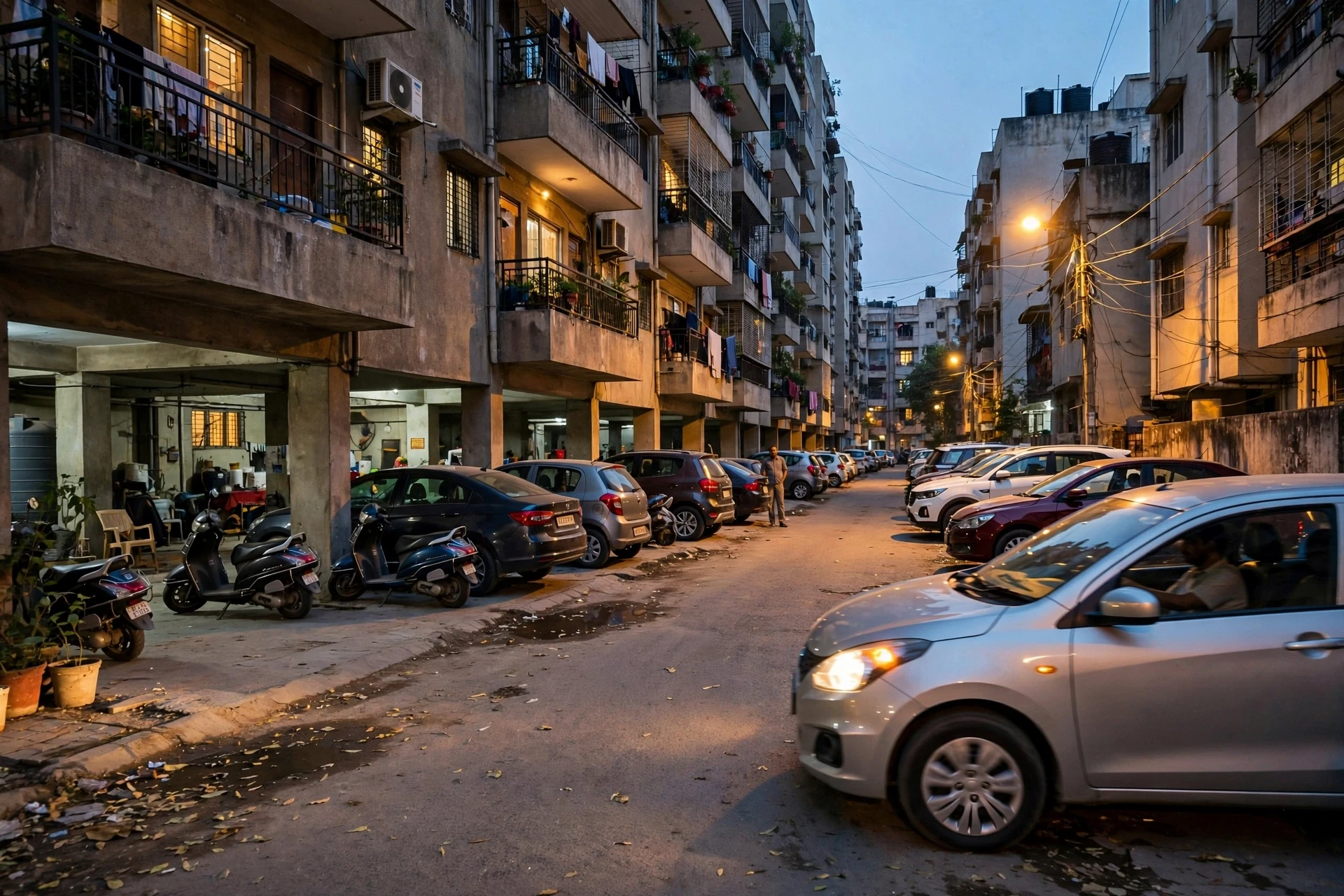
Walk the inner lanes before you judge. Older sectors were laid out as single-plotted colonies: narrow internal roads, parked cars outside boundary walls, water tanks visible on roofs, shops on the sector market street rather than inside gated clubs. DLF Phases and Sushant Lok trade that for wider planners’ grids, private security and standardised upkeep, but often with less land under your own name. If you want a low-rise builder floor in Sector 23 Gurgaon or nearby, expect a lived-in street, not a resort. That is not a flaw; it is a different asset. Check what you are actually buying in a builder floor in Sector 23 Gurgaon – carpet area, land share, and freehold title – because older-sector listings sometimes blur these.
Before you commit anywhere in the older sectors, walk the lane twice: once on a weekday morning, once after 8 pm. Parking, water and street lighting all show their true state then.
What builder-floor stock, plot sizes and parking should buyers expect?
Old Gurgaon stock is mostly floors built on plots that were carved decades ago. In Sectors 4, 14 and 23, you will see 2BHK and 3BHK single floors on plots of roughly 125 to 300 square yards, often held in lal dora-adjacent or jointly plotted layouts. Some plots are narrow frontage, deep-body, which changes where staircases and parking land. Before you compare two listings, check what each seller means by area. [VERIFY: typical plot size ranges per sector.]
How should plot size and floor area be compared?
Ask for three numbers, not one. Plot area, in square yards, tells you the land share. Built-up area covers walls and balconies. Carpet area is what you walk on. A 3BHK quoting 1,800 sq ft super area may give you 1,100 sq ft of carpet. Also ask whether the floor is stilt-plus-3 or builder-installed lift. That single detail changes privacy, parking and resale appetite. Compare plot-to-floor ratio across shortlisted options; a wider frontage usually beats extra depth.
What do road width and parking mean on the ground?
Sector master plans mark road widths on paper. Walk the lane instead. A 12-metre road with cars on both sides functions like a 9-metre one. Stand at the plot during evening peak and see whether a second car can actually turn in. Ground-floor stilt space is often shared informally between floors, so confirm parking is written into the sale agreement, not just promised.
How do markets, metro access and arterial roads affect daily life?
Daily life in Sectors 4, 14 and 23 runs on the old city grid. You are close to shops, schools and hospitals, but the trade-off is narrower lanes and slower vehicles. How well a floor works for you depends on which market cluster and road spine it sits near.
How close is each floor to the Old Gurgaon market and daily services?
[VERIFY: market proximity distances and drive times per sector] Sector 14 sits next to the Huda Market and Sadar Bazar belt, so groceries, clinics and banking stay within a short cycle ride. Sector 4 leans on the Jharsa and Civil Lines stretch, while Sector 23 buyers use the Sadar and Model Town side. Walk the lane on a Sunday morning before you trust a map app.

Which metro and arterial-road routes are actually useful?
[VERIFY: nearest metro station, current line status and station-to-sector distances] The metro connection helps most if you work along MG Road or need the airport via the Yellow Line. For daily drives, the Pataudi Road and Jharsa Road spines matter more than the metro map. Check at 8:30 am and 6 pm how fast each arterial road actually moves.
Tip: Count right turns needed to reach the main road. Two turns on a wide lane beat one turn on a single-car-width street.
What should buyers check for summer water, power and construction quality?
Ask for evidence, not assurances. In Old Gurgaon sectors, the difference between two floors on the same lane often shows up in June, not in the brochure.
How can a buyer test water and power arrangements?
Visit on a weekday afternoon between 2 and 4 pm, when taps run weakest. Open every tap on the top floor and time how long it takes to fill a bucket. Ask the seller to show the booster pump, the underground tank capacity and the borewell, if any. Then ask neighbours on the lane how often the municipal supply fails and what they pay a private tanker. Do the same for power: check the sanctioned load on the meter, count the ACs it must carry, and ask about inverter or generator backup. [VERIFY: typical summer supply hours in Sectors 4, 14 and 23]
Which physical details reveal maintenance risk?
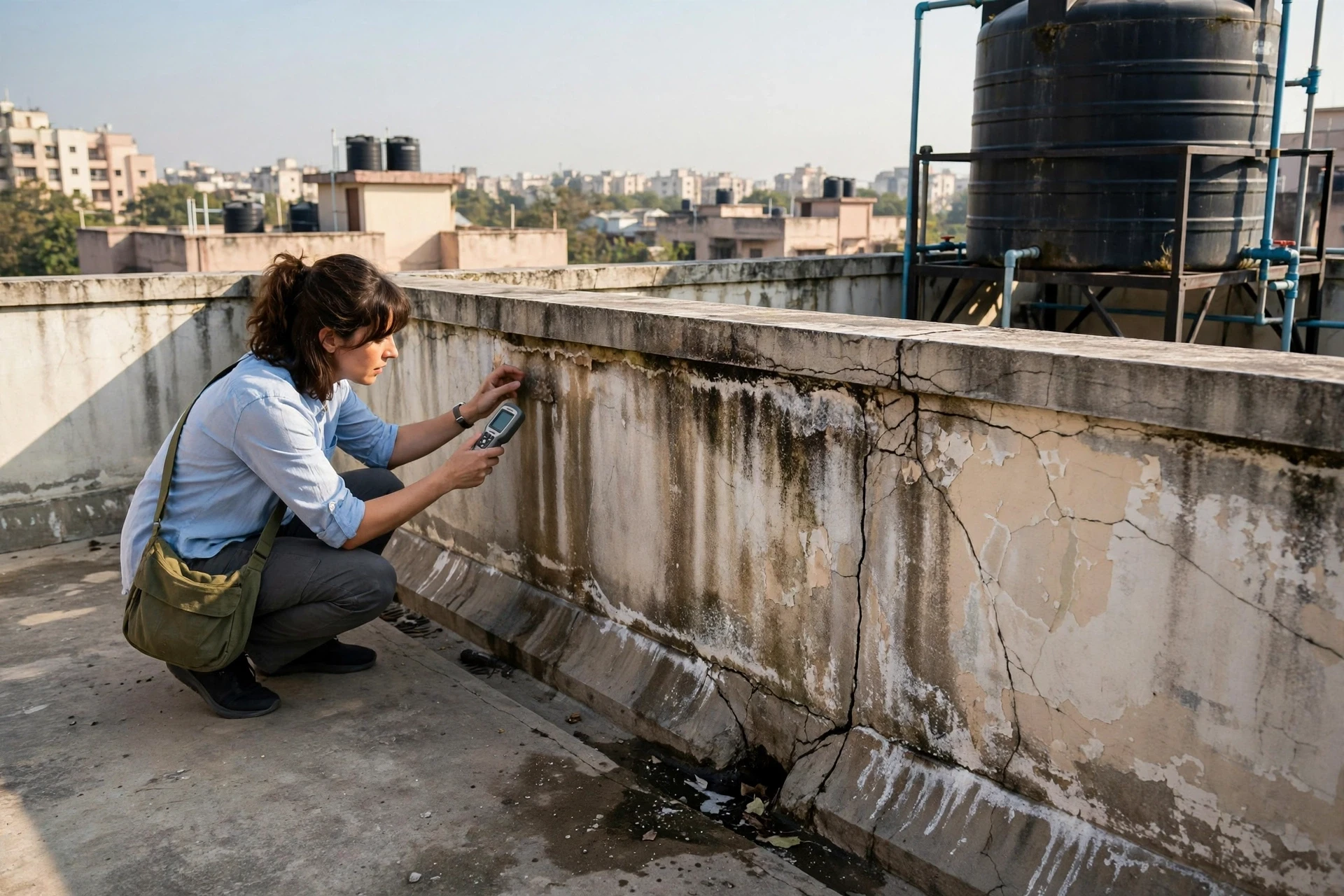
Walk the roof. Cracked terrace waterproofing, standing water stains and patched seepage near parapets return as leaks within a monsoon or two. Inside, look at corners near bathrooms for fresh paint over damp, check the slope of balconies towards drains, and test every switchboard under load. Hairline plaster cracks at beam joints are common; diagonal cracks in walls are not.
What registry, licence and RERA checks apply before buying?
Old Gurgaon plots change hands often, and paperwork gaps show up late. Run the checks below before you pay any booking amount.
Which plot-specific documents should be reviewed?
Start with the sale deed chain: ask for the last 30 years of registry records. In Sectors 4, 14 and 23, many plots were allotted in the 1970s and resold several times, so a single registry is not enough. Verify the jamabandi and mutation entries confirm the seller’s name. Pull the khasra number and confirm the plot’s dimensions match the physical site. Ask for the latest property tax receipts and an encumbrance certificate showing no mortgage or litigation. In Old Gurgaon, check for any HUDA (now HSVP) allotment conditions that still bind the plot.
How should sanctioned plans, licence status and RERA be checked?
Request the sanctioned building plan from the Municipal Corporation of Gurugram and compare it to what stands on site – extra floors or a covered stupa are common here. If the floor is under construction by a builder, confirm the DTCP licence for the colony or plot and the project’s Haryana RERA registration on the official portal; search the RERA number yourself rather than accepting a photocopy. A completed resale floor needs no RERA, but the completion or occupation certificate still matters. Our due diligence guide walks through each document in order. Use a lawyer for the title search; use a builder you can visit for the rest.
Which sector fits your priorities, and how should you judge value?
How should an end-user or investor make the final comparison?
Match the sector to the use, not to the listing price. If you want walkable access to Sadar Bazaar and the old market, and daily life on foot, Sector 14 usually wins. Sector 4 and Sector 23 trade some of that convenience for quieter lanes and, in places, more recent floor stock. An end-user should prioritise road width, parking, and summer water and power; an investor should look at land share, rental demand from Old Gurgaon’s established workforce, and resale depth.
Judge value the same way in all three: verified carpet area, not super area; clear title and licence checks on that exact plot; and what you observe on the street at 8 pm, not in a brochure. Narrow it to two or three specific floors, then compare those, not sectors. That is the conversation worth having before comparing Gurugram’s luxury sectors.

Shortlisting in Sectors 4, 14 or 23? Talk to us at Homezop and walk the lanes with someone who builds there. We will arrange a private site visit and a frank assessment, floor by floor.
Frequently Asked Questions
Q1: Is a builder floor in Sector 23, Gurgaon a good investment in 2026?
Yes, if the plot is freehold and the floor carries clear land share. Verify the registry, then judge resale demand on road width.
Q2: What is the price of builder floors in old Gurgaon sectors 4, 14 and 23?
Rates vary by plot size, floor level and frontage. Ask for per-square-yard plot rates and carpet area separately. [VERIFY: current price ranges]
Q3: How do builder floors in Sector 4 differ from Sector 14 and Sector 23?
Sector 14 sits closest to the old market and metro; Sector 4 and 23 offer quieter lanes and wider plots. Walk each street before deciding.
Q4: Why buy an independent floor in old Gurgaon instead of a high-rise apartment?
You hold land share, control your utilities, avoid society charges and live in a low-density street. Apartments trade that for shared amenities.
Q5: Which old Gurgaon sectors offer the best land share with builder floors?
Land share depends on plot size, not sector. Larger plots, roughly 300 square yards and above, give each floor a bigger undivided share.
Q6: What amenities should I expect in a luxury builder floor in Gurgaon?
Expect a private lift or stilt parking, dedicated power backup, quality fittings, covered parking per floor and, in better builds, terrace rights.
Q7: What is the rental yield for builder floors in Sector 14, Gurgaon?
Yields typically track Gurgaon’s low-rise market, around 2-3 percent annually, with family tenants favoring full floors. [VERIFY: current Sector 14 rents]
Q8: How far are sectors 4, 14 and 23 from Gurgaon’s key business hubs?
All three sit on Gurgaon’s western side, so Cyber City commutes run longer than from Golf Course Road. [VERIFY: actual drive times]
Choosing the Right Old Gurgaon Sector
The three sectors suit different buyers. Sector 4 works for those who want the oldest, most central lanes and can accept narrower streets. Sector 14 offers wider roads and the strongest daily-use market access. Sector 23 gives more breathing room and easier connectivity, often at similar budgets.
In each case, verify the same three things before you commit: title and licence on the plot, water and power behaviour in peak summer, and actual carpet area versus what the floor plan suggests. Walk the lane at different hours before you decide. Our builder floor due diligence guide covers each check in detail.