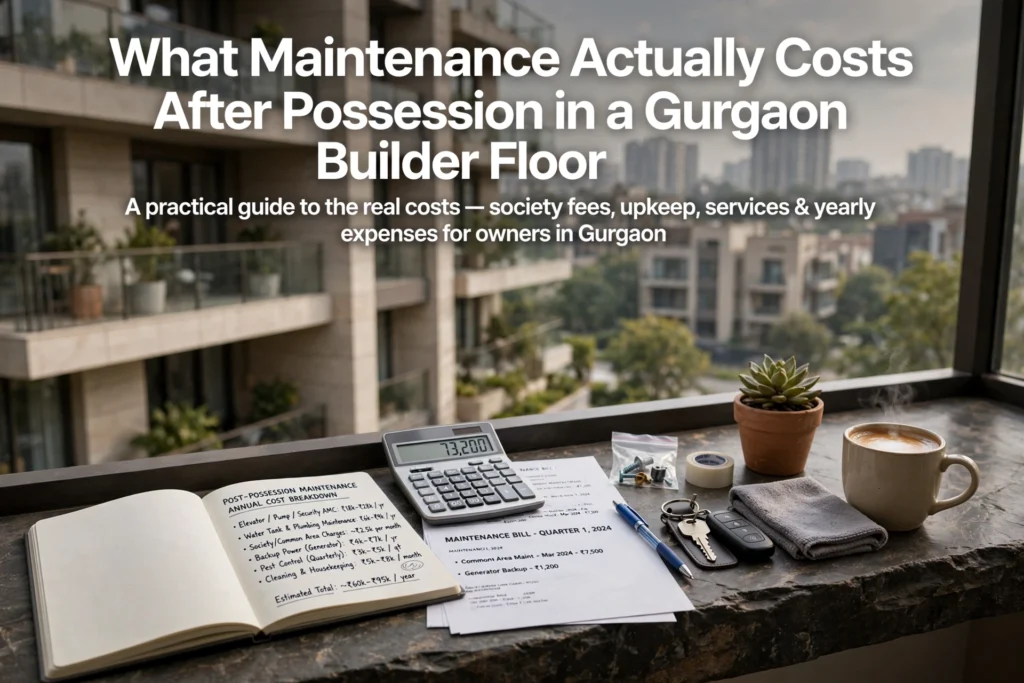

Quick Summary: Builder floor maintenance in Gurgaon is not covered by any RWA, so the four families in a building must split lift AMC, common power, summer water tankers, DG diesel, guards, property tax, insurance and a sinking fund themselves. Costs usually land below a gated society’s per sq ft rate, but only if the owners set a monthly budget and keep a written reserve for repainting, waterproofing and lift overhaul. Skip that reserve and the same costs return as a Rs 5-10 lakh special repair a few years later.
A four-floor building in Sector 57 can look quiet on possession day. Then the first summer arrives, the tanker bill lands, and the lift service invoice follows. That is when builder floor maintenance cost Gurgaon becomes real money rather than a line someone skipped.
This article breaks the running cost of an independent floor into its actual heads: lift AMC, power, water, DG fuel, guards, tax, insurance and a sinking fund. We show how four families split each bill, and how builder floor vs society maintenance compares month to month.
We build floors in Gurugram for a living, so these figures come from our owners’ ledgers, not brochures. Sinking fund builder floor planning and seasonal spikes are covered too.
[VERIFY: all figures throughout this article.]
What should a builder floor maintenance budget include?
Separate shared running costs from your own household bills
Start by splitting two very different sets of money. The first is what your family spends alone: electricity for your own meters, cooking gas, internet, housekeeping and private garden care. The second is what the four families share. That shared list is the real builder floor maintenance cost Gurgaon owners tend to under-budget. It covers lift AMC and its power, common-area lighting and cleaning, water supply including tanker purchases through summer, DG diesel and servicing, guard contribution, CCTV and barrier upkeep, and property tax on common areas. List every head in [VERIFY: annual amount per head] so nothing sits hidden in a drawer.
Convert monthly invoices and irregular repairs into an annual view
Monthly bills are only half the picture. Repainting, roof waterproofing and lift overhaul arrive in bursts, so set aside a sinking fund each year instead of scrambling later. A simple [VERIFY: annual sinking fund contribution] per family covers these without arguments.  Total the monthly and the annual heads together. That gives you the honest independent floor running cost to compare against a society’s maintenance rate. If you are still choosing between formats, our builder floors in Gurgaon pages show what ownership looks like in practice.
What do lift, lighting, cleaning and security cost to run?
These four heads form the fixed monthly core of any builder floor maintenance cost in Gurgaon. In a four-family floor, each head is shared, but nobody bills you automatically. You and your co-owners set the amount, then pay it.
Lift AMC and common-area electricity
A residential lift needs an annual maintenance contract covering visits, parts and the annual inspection. The premium for a standard home lift runs to a specific yearly figure, split four ways, so your share is a quarter of it. Ask to see the AMC document before you commit, not after. On top of that sits common-area electricity: lobby lights, stairwell lighting, the lift motor and the exhaust fans in the basement. This draws on a separate meter, and the bill varies with season and usage. Budget a fixed monthly amount per family and reconcile it against the actual meter reading each quarter.
Cleaning, guard contribution and access systems
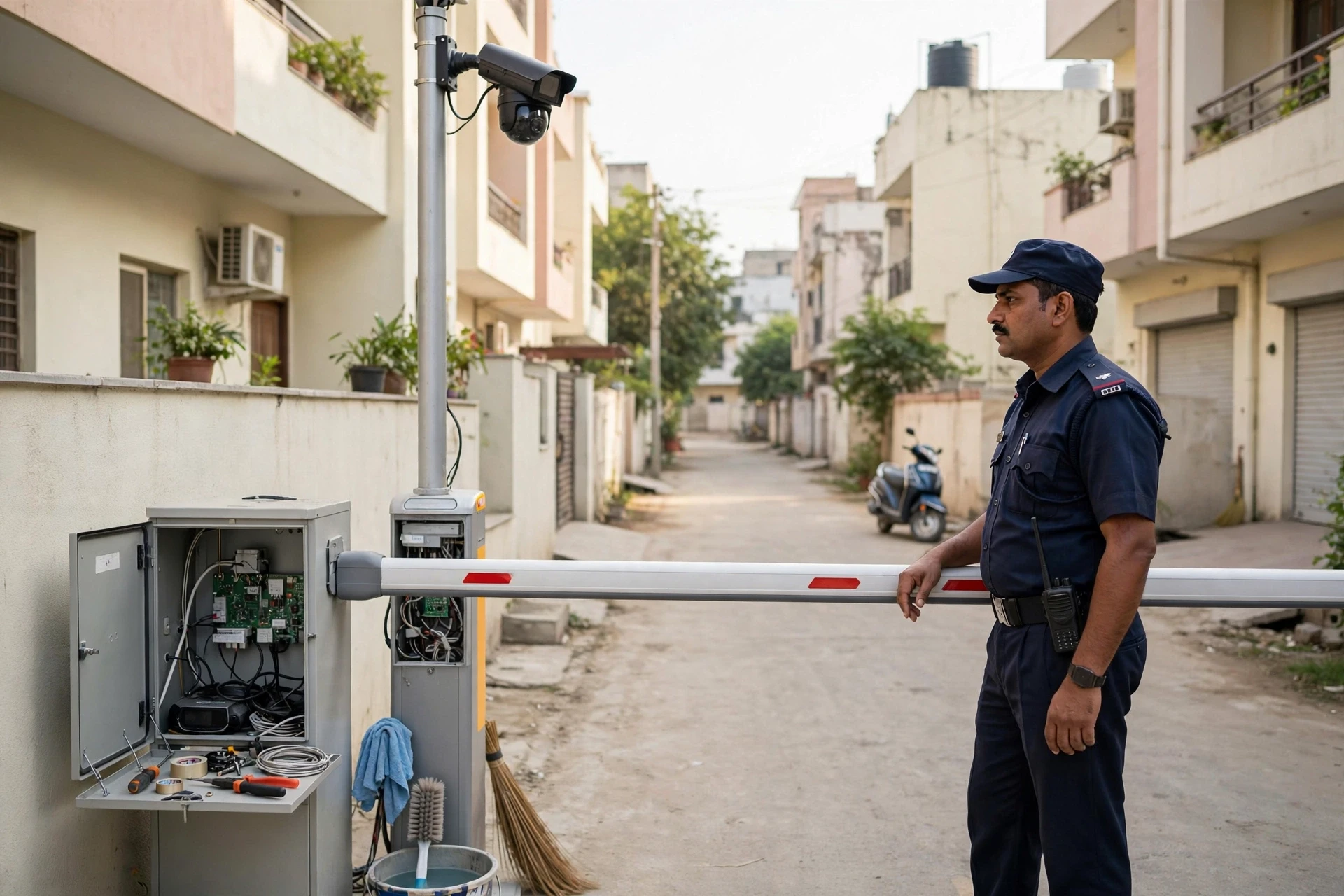
Daily sweeping and mopping of the stairease and lobby, plus periodic facade cleaning, usually goes to one shared housekeeping arrangement funded by all four families. Security works differently on a builder floor. There is no estate security to lean on, so owners typically contribute to a local guard posted at the lane or cluster level, along with CCTV and the barrier at the entry point. The camera recorder, wiring and barrier motor all need occasional repair, so keep a small annual amount aside for that too.
Ask for the previous year’s actual bills for lift, electricity and security before you buy. Real numbers beat any estimate.
How should you budget for water and DG in Gurgaon summers?
Track municipal supply, storage and summer tanker purchases
Water looks free on paper and rarely stays that way. MCG supply runs through the year, but pressure and timing vary by sector, so most four-family floors hold underground and overhead tanks as a buffer. From May to July, demand peaks just as supply thins, and tanker purchases begin. Price each load before you assume the cost, because rates move with distance and season. Record every delivery for one summer and you will have a real number, not a guess, for the water line in your builder floor maintenance cost Gurgaon budget.

Budget DG fuel, operation and servicing separately
The DG set is the second summer variable. Outages climb with temperature, so diesel burn in June can run several times the January figure. Split the head into three parts: fuel, priced per litre and metered per flat; running costs such as oil top-ups and filters; and the annual service by the OEM or a certified technician. Meter each family’s units, bill actual consumption, and keep a log. That separates fair billing from argument, and it stops one heavy user quietly subsidising another.
Which annual and long-term costs are easy to miss?
Include property tax and insurance without double counting
Two annual heads sit outside the monthly split, and owners often forget them. Property tax in Gurgaon is billed by the municipal corporation, so each of the four families pays on its own floor unit. Check the current rate and basis with the MCG portal [VERIFY: current MCG residential property tax rate per sq yard or per sq mt]. Home and structure insurance is the second head. A single floor-wise policy usually costs less than four separate ones [VERIFY: indicative premium range for a Rs 4-10 crore floor]. Budget these yearly, not monthly, and keep them out of the shared ledger so nobody pays twice.
Build a sinking fund for repainting, waterproofing and lift overhaul
A builder floor has no RWA to collect a sinking fund, so the four owners must create one themselves. The logic is simple: put aside a fixed amount every month for costs that arrive in lumps, not every month.
Three big ones repeat on a cycle:
- Exterior repainting and facade repair, typically every 5-7 years
- Terrace and bathroom waterproofing, often needed sooner in Gurgaon’s monsoon [VERIFY: typical waterproofing redo cost for a floor]
- Lift overhaul or replacement, usually quoted after 10-12 years [VERIFY: indicative lift overhaul cost]
A practical target is to hold [VERIFY: suggested monthly contribution per family] per family in a joint account, reviewed yearly. Every figure above should be quoted by vendors before you commit, not guessed.
How do four households share the cost, and what changes without an RWA?
Calculate a household contribution from verified building costs
Start with one number: the building’s total annual running cost. Add every head together – lift AMC and its electricity, common-area lighting and cleaning, water including summer tanker purchases, DG running and servicing, guard contribution, CCTV and barrier upkeep, property tax, insurance, and the sinking fund for repainting, waterproofing and lift overhaul.
Then divide by four. On a floor with one lift and one guard, the split is usually equal per family. Some groups weight it by floor area instead, because the top floor often uses the lift more. Either method works; pick one at possession and write it down.
What changes without an RWA is simple: nobody sends you a bill. In a gated society, maintenance is charged per sq ft and collected by a managing committee. Here, the four families must create the arrangement themselves – a shared account, a monthly date, and a named person who pays the vendor.
This is the money side only. For how shares and rights are allocated, see our due diligence guide.
Is a builder floor cheaper to maintain than a gated society?
Usually yes, but only on a like-for-like basis. A Gurgaon society quotes one monthly rate covering club maintenance, manpower, gardens and a corpus. A four-family builder floor has no RWA, so each head is priced and shared directly between the owners.
Compare the same services, area basis and reserve provision
Start with the service list. A fair comparison covers the same scope: lift, common lighting, water supply, DG power, guards, CCTV and repairs. Societies add amenities a floor simply does not carry, so their headline rate includes services you may not want.
Next, match the area basis. Society rates are typically quoted per sq ft of super area, while floor costs divide by four. Convert both to a monthly rupee figure per family before judging.
Finally, insist on reserve provision in both cases. A society corpus handles repainting and lift overhaul; your floor needs its own sinking fund, and a comparison that ignores it flatters the builder floor. Cost per family is often lower, but the honest number includes the fund. For context on how floors differ from apartments, see our guide to builder floors in Gurgaon.

If you want a real-world walk-through of maintenance costs before you commit, talk to us at Homezop. We will share actual running numbers from a comparable four-family floor, or arrange a quiet site visit. No pressure, just answers.
Frequently Asked Questions
Q1: How much does maintenance cost per square foot in a Gurgaon builder floor?
It varies by spec and locality; treat any quoted rate as [VERIFY: per-sqft maintenance range] until audited.
Q2: Is a builder floor cheaper to maintain than an apartment in Gurgaon?
Usually yes, because four families share costs without society overheads.
Q3: How do maintenance charges work when there is no RWA in a builder floor?
Owners set up their own shared cost arrangement, typically monthly.
Q4: What is the interest free maintenance deposit charged at possession in Gurgaon?
A refundable corpus the builder holds; confirm the amount and refund terms in writing.
Q5: Can the builder increase builder floor maintenance charges every year?
Yes, if your agreement permits it; check the escalation clause before signing.
Q6: Are maintenance charges for a Gurgaon builder floor calculated on land share?
Typically no; costs are split equally or by usage among co-owners.
Q7: Can the builder charge maintenance without an occupancy certificate in Gurgaon?
Yes, per agreement terms, but service standards may not yet be certified.
Q8: How liquid is a builder floor resale in Gurgaon compared to an apartment?
Builder floors in prime sectors sell reasonably well; buyers value land share.
Conclusion
A builder floor’s real cost begins at possession, not at booking. Lift AMC, DG running, water tankers in summer, guards, common-area power, property tax, insurance and a sinking fund for repainting and waterproofing. On a four-family floor, there is no RWA to run this for you. The four families must set the budget, collect it monthly and keep a written reserve. Done well, the total usually stays below a gated society’s maintenance bill. Done loosely, it surfaces as a Rs 5-10 lakh special repair a few years later. Budget honestly now, and living in a Gurgaon builder floor stays predictable.## Conclusion
A builder floor’s real cost begins at possession, not at booking. Lift AMC, DG running, water tankers in summer, guards, common-area power, property tax, insurance and a sinking fund for repainting and waterproofing. On a four-family floor, there is no RWA to run this for you. The four families must set the budget, collect it monthly and keep a written reserve. Done well, the total usually stays below a gated society’s maintenance bill. Done loosely, it surfaces as a large special repair a few years later. Budget for it honestly now, and owning a Gurgaon builder floor stays predictable, not surprising.