
Quick Summary: The quoted super built-up area is not the space you actually live in, so compare homes by RERA carpet area and effective price per usable square foot. A 2,500 sq ft quote at 25% loading gives 2,000 sq ft of carpet area, but at 40% loading it drops to 1,786 sq ft, raising the effective rate from Rs 25,000 to about Rs 28,000 per carpet sq ft. Low-rise builder floors often have lower loading than high-rise towers because they share fewer common areas, but lower loading alone doesn’t guarantee better value. Always check the sanctioned plan, area statement, and agreement for sale, and ask for carpet area, balcony, terrace, and land share as separate figures before paying.
A 2,500 sq ft quote in Gurugram may give you 2,000 sq ft of RERA carpet area at 25 percent loading, or about 1,786 sq ft at 40 percent. The headline area stays the same. Your lived space does not.
That gap is why carpet area vs super built up area and carpet area vs built up area matter before you compare prices. Many buyers know the quote, but not the super built up area meaning, the loading factor real estate calculation, or the RERA carpet area definition.
As a builder of independent floors, we publish carpet area openly. This guide shows the arithmetic, effective price per usable sq ft, and why low-rise homes often carry lower loading than towers. It will make carpet area vs super built up area and carpet area vs built up area easier to assess.
What Is the Difference Between Carpet Area, Built-Up Area and Super Built-Up Area?
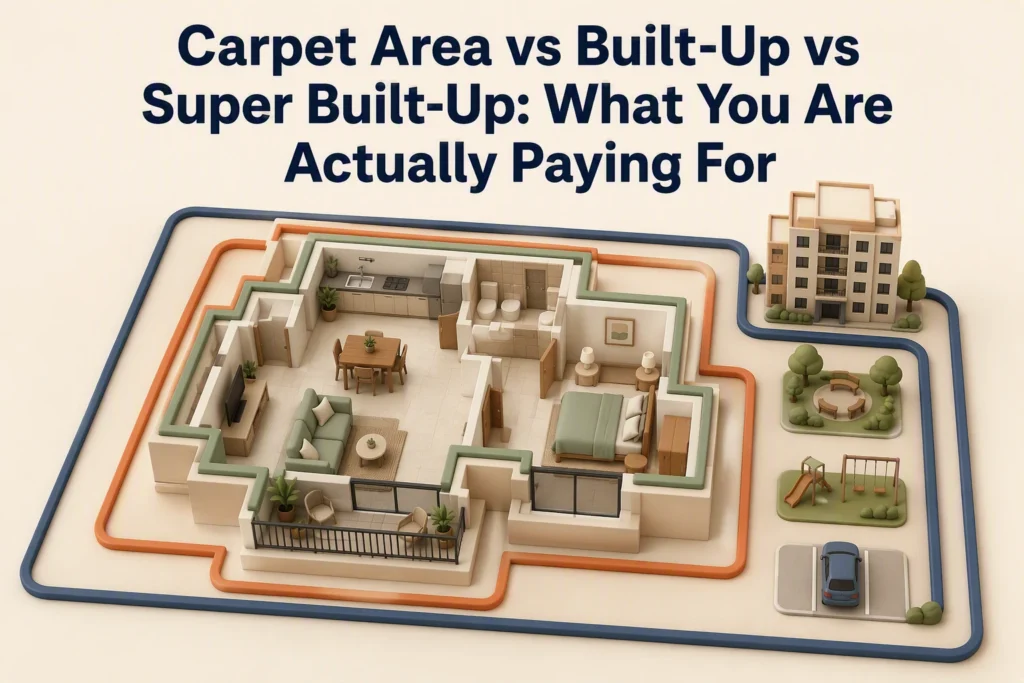
The difference is simple: carpet area is space you use, built-up area adds walls and private outdoor space, and super built-up area also adds a share of common facilities. For any Gurgaon purchase, compare homes on carpet area first.
Carpet Area: The RERA Measure of Net Usable Floor Area
Carpet area is the net floor space within your home where you can place furniture and live. Under RERA, it includes internal partition walls but excludes external walls, service shafts, exclusive balconies or verandahs, and exclusive open terraces. Buyers can review approved plans and project details as part of their rights under RERA guidance for allottees.
In practical terms, this covers bedrooms, living areas, kitchen, bathrooms and passages.
Ask for the carpet-area figure in writing, then match it against the sanctioned floor plan and agreement for sale.
The comparison of carpet area vs built up area tells you how much space walls and private projections add. Carpet area vs super built up area tells you how much of the quoted size is not inside your home.
Built-Up Area: Carpet Area Plus the Constructed Envelope
Built-up area adds the thickness of external and internal walls to carpet area. It may also include balconies, terraces, or utility areas, depending on the seller’s stated method.
This number helps assess the physical envelope of an independent floor in Sector 57 or Nirvana Country. It is not, however, the statutory measure of usable space.
Super Built-Up Area: The Private Home Plus a Share of Common Areas
Super built-up area adds your allocated share of common areas, such as lobbies, lifts, stairs, corridors, clubhouse space, and shared services. It is often used to quote apartment size and price.
The definition can vary by project. In carpet area vs built up area, check what is added. In carpet area vs super built up area, ask for the loading calculation and the exact common areas included.
Also Read: 08
What Does RERA Require About Carpet Area in Gurugram?
The Section 2(k) Definition You Should Read Literally
RERA defines carpet area as the apartment’s net usable floor area. It excludes external walls, service shafts, exclusive balconies or verandahs, and exclusive open terraces. It includes internal partition walls.
Read the statutory Section 2(k) definition literally. A private balcony may add real lifestyle value, but it is not carpet area. Nor is a terrace, however large.
Ask for carpet area, balcony area, terrace area, and any common-area allocation as separate figures.

The Haryana RERA Gurugram Carpet-Area Regulations
For projects within Gurugram district, the 2021 regulations require apartments and floors to be sold on a carpet-area basis. They also treat sale on super area, covered area, saleable area, or another label instead of carpet area as an unfair practice.
The Haryana RERA Gurugram regulations apply across the district, including Golf Course Road, Sector 57, Nirvana Country, and Dwarka Expressway.
Check that the RERA filing, allotment letter, and agreement for sale all state the same carpet figure.
Disclosure Is Not the Same as a Clear Comparison
A seller can disclose carpet area and still make comparison difficult. The issue is usually the missing breakup between usable indoor space, private outdoor space, and shared common areas.
Before you compare two homes, request:
- The sanctioned floor plan with dimensions.
- Carpet area stated in the agreement for sale.
- Separate balcony, terrace, and parking areas.
- The total consideration and all non-price charges.
Compare the total price per carpet sq ft, then judge balcony, terrace, land share, and common facilities on their own merits.
Also Read: How to Verify Builder Floor Construction Quality Before Booking
How Is the Loading Factor Calculated?
The Loading Formula and Its Denominator
Loading shows how much of the quoted sale area is not carpet area. Calculate it as:
Loading % = (Super built-up area – carpet area) ÷ carpet area × 100
The denominator matters. It is carpet area, not super built-up area. Under Section 2(k) of RERA, carpet area is the net usable floor area, including internal partition walls but excluding external walls, service shafts, balconies, verandahs, and open terraces.
Ask the seller to state the formula in writing. Some quotes use a different denominator and can make loading look lower.
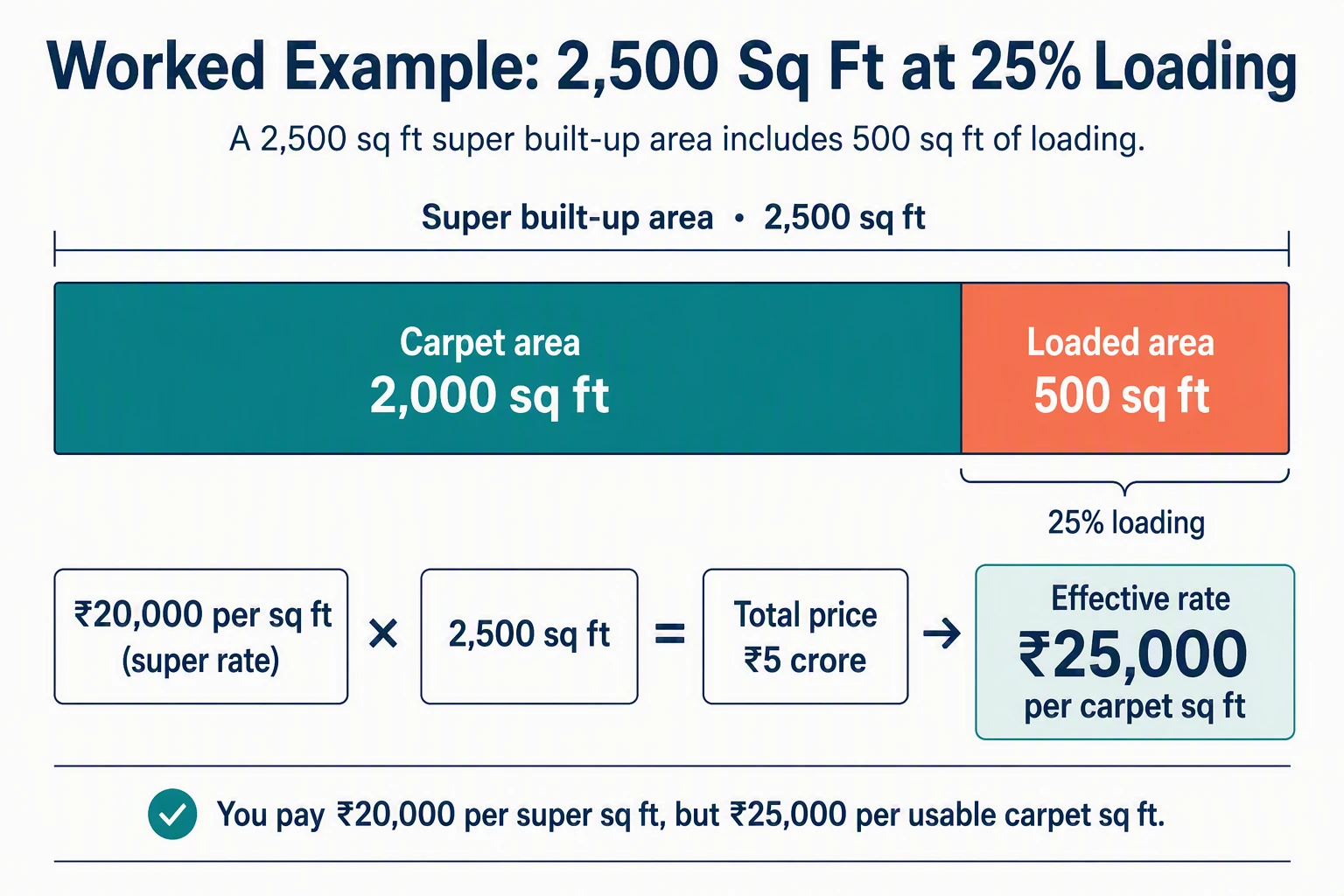
Worked Example: 2,500 Sq Ft at 25 Percent Loading
A 2,500 sq ft super built-up quote at 25 percent loading means:
- Carpet area = 2,500 ÷ 1.25 = 2,000 sq ft
- Loaded area = 2,500 – 2,000 = 500 sq ft
If the quoted rate is Rs 20,000 per sq ft, the total price is Rs 5 crore. Your effective price on usable carpet area is:
Rs 5 crore ÷ 2,000 sq ft = Rs 25,000 per carpet sq ft
| Measure | 25% loading |
|---|---|
| Super built-up area | 2,500 sq ft |
| Carpet area | 2,000 sq ft |
| Effective rate at Rs 20,000 super rate | Rs 25,000 per carpet sq ft |
Worked Example: 2,500 Sq Ft at 40 Percent Loading
At 40 percent loading, the same advertised 2,500 sq ft becomes:
- Carpet area = 2,500 ÷ 1.40 = 1,786 sq ft
- Loaded area = 2,500 – 1,786 = 714 sq ft
At the same Rs 20,000 per sq ft quote, the price remains Rs 5 crore. Yet the effective rate rises to roughly Rs 28,000 per carpet sq ft.
| Measure | 40% loading |
|---|---|
| Super built-up area | 2,500 sq ft |
| Carpet area | 1,786 sq ft |
| Effective rate at Rs 20,000 super rate | About Rs 28,000 per carpet sq ft |
The buyer pays the same total amount, but receives about 214 sq ft less usable indoor space than at 25 percent loading.
Why the Advertised Rate Can Be Misleading
Compare homes by carpet area, total consideration, and effective carpet rate. A lower super-area rate can still mean a higher price for the space you actually use.
Why Do Builder Floors and Low-Rise Homes Usually Have Lower Loading?
What Creates Loading in a High-Rise Tower
A tower spreads the cost and area of shared infrastructure across every apartment. This often includes lift lobbies, multiple lifts, fire stairs, service shafts, long corridors, refuge areas, a clubhouse, and large parking zones.
These spaces serve a purpose, but they are not inside your home. Haryana RERA notes that selling on a vague super-area basis can be misleading and requires sales to be based on carpet area in Gurugram projects under its rules. Read the Gurugram carpet-area regulations.
Why a Low-Rise Floor Can Be More Area-Efficient
An independent floor usually has fewer shared systems. There may be one stair, a compact lift, limited common passage, and no large internal amenity block to allocate.
That often leaves a greater share of the quoted area within the private residence. In Sector 57, Nirvana Country, and parts of Golf Course Road, this can mean wider living rooms, larger bedrooms, and more useful balconies for the same stated sale area.

Ask for the carpet-area plan, balcony area, and common-area breakup separately. A single super-area number does not answer the question.
Lower Loading Is Not the Same as Better Value
Low loading is a strong starting point, not the final test. Check build quality, floor plan, light, privacy, parking rights, land share, and the legal status of the plot.
A well-planned high-rise may justify more shared area if you will use its services. A low-rise floor may offer better daily space, but only if the sanctioned plan and sale deed clearly match what you are buying.
Also Read: Builder Floors vs High-Rise Apartments: Which Offers Better Value?
Which Documents Should You Check Before Buying?
Documents settle the area, price, and ownership questions that a sales sheet cannot. Ask for copies before you pay a booking amount, then have a property lawyer compare them line by line.
Start With the Official RERA Project Page
Check the project registration number, promoter name, approved completion date, land details, and uploaded approvals on the official Gurugram RERA page. Haryana rules require apartment pricing on a carpet area basis, not super built-up area, for registered projects. See the Gurugram RERA regulations.
If the seller quotes super area, ask for the carpet-area price and total consideration in writing.
Read the Sanctioned Plan and Unit Area Statement
The sanctioned plan shows what the authority approved. Match the unit number, floor, balconies, terrace rights, parking, stair and lift placement against the drawing you were sold.
Ask for a signed unit area statement showing:
- Carpet area
- Built-up area, if stated
- Balcony and exclusive terrace area
- Common-area share
- Land share for a builder floor

Make the Agreement for Sale the Commercial Reference Point
The agreement for sale should carry the final carpet area, total price, payment schedule, possession date, specifications, parking, and defect-liability terms. It should also state what happens if area changes.
Check that every commercial promise appears in the agreement, including:
- Private terrace or roof rights
- Land-share percentage
- Charges included in the quoted price
- Refund, delay, and cancellation terms
The RERA registration framework requires a prescribed agreement for sale and a conveyance deed obligation. Haryana RERA’s registration form records both conditions.
Verify Possession and Conveyance Records
For a ready home, inspect the occupancy certificate, completion certificate where applicable, and registered conveyance deed. For a low-rise floor in Gurgaon or Gurugram, also verify title chain, collaboration agreement, and the exact undivided land share.
Do not treat a possession letter as proof of title. Registration and conveyance are separate checks.
Also Read: Luxury Builder Floors in Gurgaon: Locations, Costs, and Features
How Should You Compare Properties on Carpet Area?
Compare Total Consideration Per RERA Carpet Square Foot
Start with one number: total consideration divided by RERA carpet area. Include base price, parking, club or power-backup charges, and mandatory fees. RERA defines carpet area as net usable floor area, including internal walls but excluding external walls, shafts, balconies, and terraces, as set out in the RERA Act.
| Comparison input | Property A | Property B |
|---|---|---|
| Total consideration | Rs 6 crore | Rs 6 crore |
| RERA carpet area | 2,000 sq ft | 2,400 sq ft |
| Effective cost | Rs 30,000 per sq ft | Rs 25,000 per sq ft |
Use Carpet Area for Rental and Resale Logic, Not in Isolation
Carpet area tells you how much enclosed space a tenant or future buyer can use. It is the cleanest base for comparing layouts in Gurgaon and Gurugram.
Still, do not treat it as the whole investment case. Check these alongside it:
- Bedroom sizes and usable living-room width
- Balcony, terrace, parking, and storage rights
- Street quality, access, and plot position
- Building condition and running costs
A larger carpet area with poor light or a weak layout may not command better rent.
Ask What You Own Beyond the Four Walls
A low-rise floor in Sector 57 or Nirvana Country may offer more than internal area. Ask for the undivided land share, rights in common areas, parking allocation, roof or terrace rights, and the exact terms in the registered deed.
The Haryana RERA Gurugram regulations require sale on a carpet-area basis and flag super-area-only sale language as misleading. Review the Gurugram carpet-area regulations before signing.
What Are the Most Common Mistakes Buyers Make?
Comparing Brochure Rates Without Converting to Carpet Area
A lower brochure rate can hide less usable space. Convert every quote to a per-carpet-square-foot cost before comparing homes in Gurgaon or Gurugram.
Treating a Market Percentage as a Legal Standard
Loading is a design outcome, not a legal benchmark. Haryana RERA requires sale on carpet area and treats vague super-area descriptions as problematic in its Gurugram regulations.
Ignoring Balconies, Terraces, Parking and Common-Area Rights
Ask for each item separately. RERA carpet area excludes exclusive balconies and terraces, even though they may add real lifestyle value. Confirm parking type, terrace rights, and land share in writing.
Accepting Verbal Clarifications Instead of Matching Documents
Match every claim with the sanctioned plan, agreement for sale, and area schedule. The RERA Act definition is clear. A sales conversation is not a contract.
Also Read: 2026
Frequently Asked Questions About Carpet Area and Loading
Is carpet area the space I can actually use? Yes. It is the net usable floor area, including internal partition walls but excluding external walls, shafts, balconies, and open terraces under the RERA Act definition.
What is a good loading percentage? Lower is usually better, provided the plan, lift, parking, and common areas remain practical. Low-rise builder floors in Gurgaon often have less shared circulation than towers.
Can a seller quote super built-up area? Ask for carpet area first. Gurugram regulations require apartments and floors in covered projects to be sold on carpet area, not vague super area terms, as set out by HRERA Gurugram.
Request the sanctioned plan, area statement, and draft agreement before paying any token.

If you are comparing a Gurgaon floor or apartment, ask to see carpet area, land share, and the full area statement before you price the home. Homezop publishes these details clearly. Arrange a private site visit or speak directly with our founder.
Frequently Asked Questions
Q1: What is the difference between carpet area and built-up area?
Carpet area is usable indoor space, excluding external walls, balconies, and common areas. Built-up area adds wall thickness and usually private balconies or terraces. It is larger, but not all of it is practical living space.
Q2: How is super built-up area calculated with loading factor?
Super built-up area equals carpet or built-up area plus a share of common areas. Divide super area by 1 plus loading. At 25% loading, 2,500 sq ft super area gives 2,000 sq ft before other adjustments.
Q3: What is the loading factor in real estate and what is a good percentage?
Loading is the gap between usable area and quoted sale area. Lower is usually better. Low-rise floors often have lower loading than towers, but assess the lift, lobby, stair, parking, and terrace rights too.
Q4: Does RERA require carpet area disclosure?
Yes. RERA requires promoters to disclose carpet area in sale documents. Ask for the sanctioned plan and agreement draft, then match the stated carpet area with the unit layout.
Q5: How do I calculate the carpet area of my apartment?
Measure each usable internal room, including internal partition walls where applicable under RERA. Exclude external walls, service shafts, balconies, and terraces. A licensed architect can verify disputed measurements.
Q6: What is the standard carpet to super built-up area ratio?
There is no fixed standard. A higher ratio means less loading. Compare the carpet-to-super ratio across similar homes, then judge whether shared amenities justify the area you are funding.
Q7: Why do developers quote super built-up area instead of carpet area?
It lets developers price the home with shared spaces included. That is not inherently wrong, but it can hide the usable-area gap. Compare homes on carpet area and effective price per usable square foot.
Q8: What documents should I check for area transparency before buying a property?
Check the RERA registration details, sanctioned plan, unit plan, sale agreement, area schedule, and title documents. Confirm balcony, terrace, parking, and common-area rights separately before paying any booking amount.
Conclusion
The quoted super built-up area is not the space your family will live in. Compare carpet area, built-up area, loading, land share, and total consideration before judging value.
For a Gurgaon or Gurugram home, lower loading in a well-planned low-rise can mean more usable rooms, fewer shared cores, and clearer value per usable sq ft. The legal baseline is clear: RERA defines carpet area as net usable floor area, with specific exclusions.
Ask for the sanctioned plan, area schedule, and agreement for sale. Match every quoted figure before you commit.