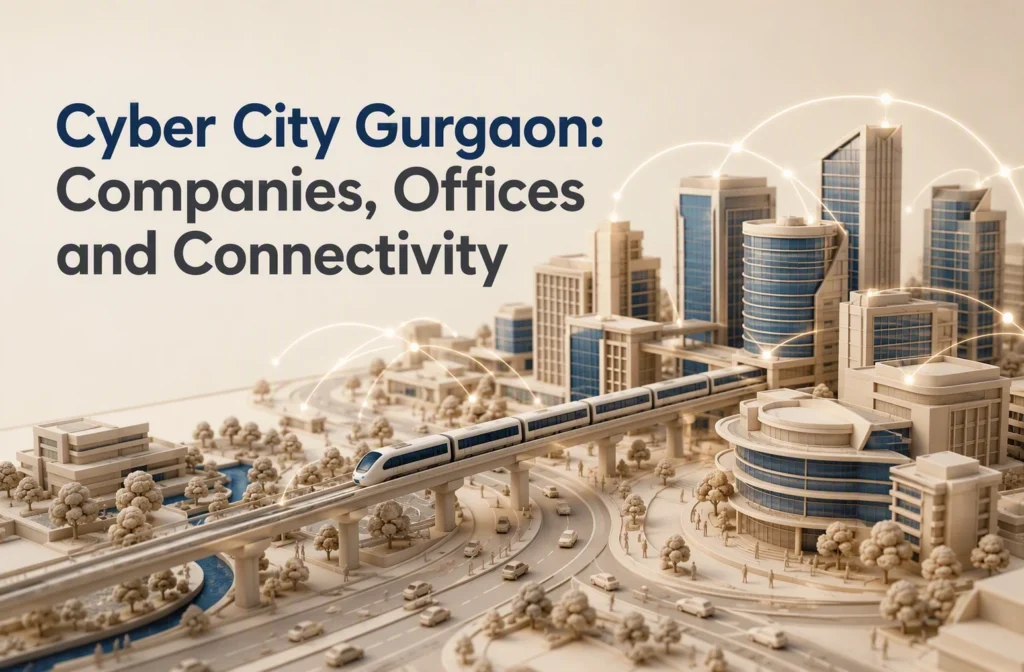

Quick Summary: Cyber City Gurgaon is a 125-acre office district beside NH-48 with major firms like Gartner, BCG, and American Express, plus Rapid Metro access via Sikanderpur. The key for homebuyers is matching the home to the commute pattern: DLF Phase 2, Phase 3, and Udyog Vihar suit short drives, while Golf Course Road and Sectors 42-56 work better for metro-first commuters. Cyber Hub is the dining and social precinct, separate from the office towers, and peak-hour traffic on NH-48 and internal roads is the main constraint to test before buying.
A short drive can become a long daily task when junctions, merges, and parking sit between home and a Cyber City tower. For many buyers, Cyber City Gurgaon is not simply an office address. It shapes school runs, dinner plans, travel time, and the value of a home.
This guide maps the business district, its office campuses, major employers, Cyber Hub, and the real transport links through Rapid Metro, Sikanderpur, and NH-48. It also separates a nominally nearby address from a genuinely workable commute.
We build and assess homes across Gurugram, so we see how road access and daily routines affect buying decisions. Use this guide to judge Cyber City Gurgaon on practical terms, then compare nearby residential areas with clear eyes.
What Is Cyber City Gurgaon and Why Is It a Prime Office Location?
Where Is DLF Cyber City Located?
DLF Cyber City sits in east Gurugram, beside NH-48 near the Delhi-Gurugram border. It faces Udyog Vihar across the highway and lies close to DLF Phase 2 and Phase 3.
The district combines office towers, internal roads, pedestrian links and Cyber Hub. DLF states that the campus spans about 125 acres with roughly 15 million sq ft of workspace. Its location page also notes direct Rapid Metro access and a 9 km road route to the airport.
For a daily commute, the exact tower matters. A home near the right Rapid Metro stop can remove the need to cross NH-48 by car.
How Cyber City Became a Business District
Established in 2003, Cyber City grew as a concentrated office district for technology, IT-enabled services, finance, consulting and global corporate teams. Wikipedia’s overview identifies it as a major IT activity hub in Delhi NCR.
Its appeal is practical:
- Large office floor plates for enterprise teams
- A Rapid Metro loop linked to the Yellow Line at Sikanderpur
- NH-48 access for Delhi, the airport and Manesar
- Cyber Hub for meetings, meals and after-work time
| Business advantage | What it changes |
|---|---|
| Clustered towers | Shorter movement between offices and client meetings |
| Metro connection | A workable alternative during peak road traffic |
| Cyber Hub | Dining and informal meeting options within the district |
Also Read: 2026
Which Companies and Sectors Are Based in Cyber City Gurgaon?
Cyber City brings together large global offices, shared-service teams, and corporate support functions. For homebuyers, that mix matters because it creates steady weekday travel into this part of Gurgaon.
What Business Sectors Operate from Cyber City?
The district has a strong base in technology, IT-enabled services, banking, consulting, telecom, and corporate services. It also supports global capability centres, where overseas firms run finance, data, engineering, HR, and customer operations from Gurugram.
DLF describes Cyber City as a 125-acre office district with about 15 million sq ft of workspace, serving global firms and enterprise teams on its Cyber City overview.
| Sector | Typical work carried out |
|---|---|
| Technology and IT | Software, cloud, data, product support |
| BFSI | Banking operations, risk, payments |
| Consulting | Advisory, audit, tax, strategy |
| Telecom and industrial | Networks, energy systems, equipment |

A Cyber City address does not always mean a company headquarters. Many firms operate major regional or shared-service offices here.
Which Major Companies Are Associated with Cyber City?
Named occupiers include Gartner, BCG, Bank of America, Expedia, EY, WPP, Reckitt, American Express, Nokia, Schneider Electric, Tetra Pak, and Toshiba. Company locations can change by tower or lease cycle, so verify the current office address before planning a commute or home purchase.
The mix is broad rather than tech-only. That gives Cyber City a more resilient daily workforce across sectors, not just one industry.
- Financial services teams often work fixed office hours.
- Consulting and technology teams may have longer or hybrid schedules.
- Corporate visitors add pressure around lunch and evening hours.
Also Read: 08
What Are the Main Towers, Campuses, and Office Amenities in Cyber City?
Which Office Buildings and Campuses Define the District?
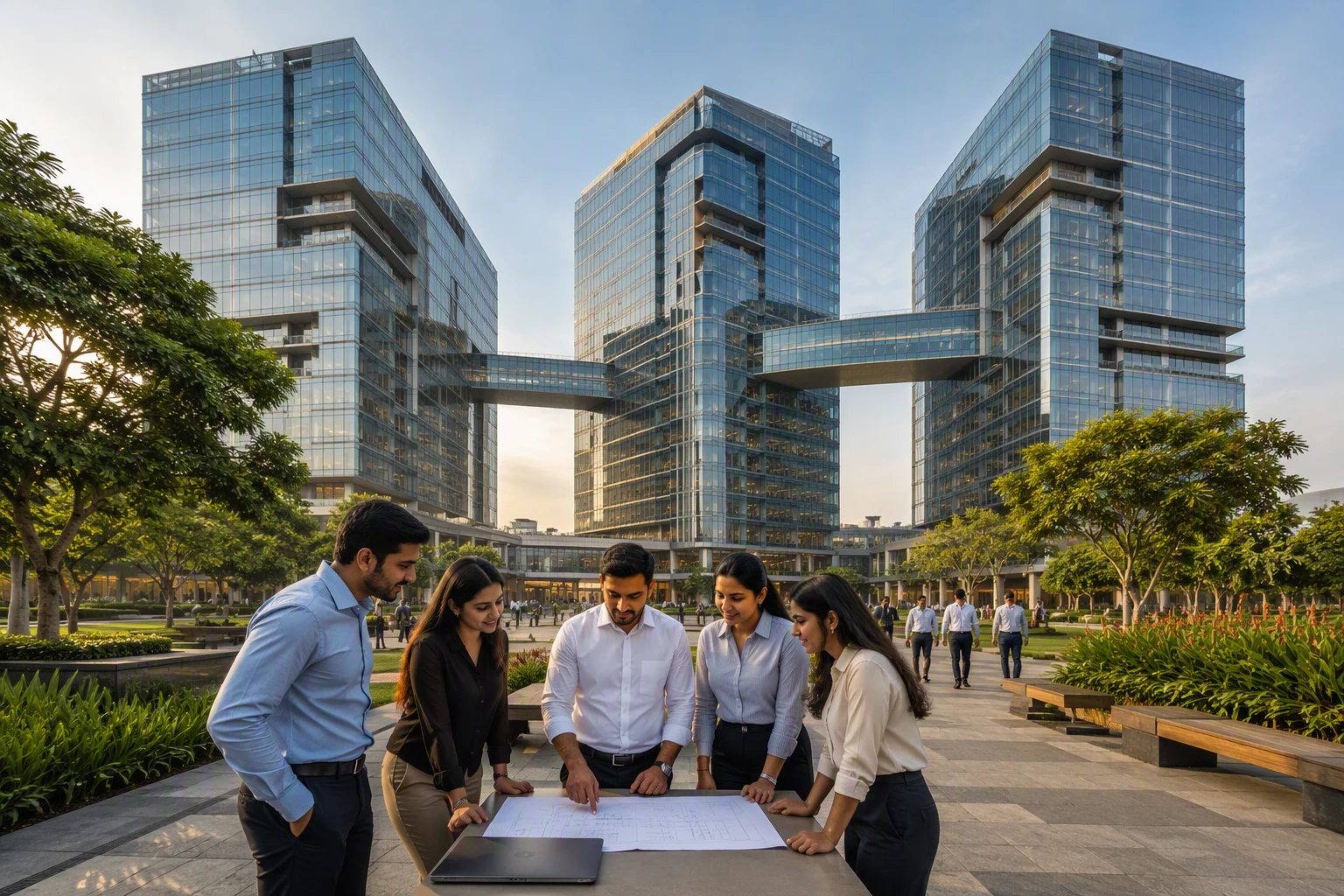
Cyber City is a cluster of large corporate buildings rather than one office complex. Its core addresses include Buildings 6, 7A and 7B, 9A and 9B, 10 and 14, alongside Cyber Greens, Epitome, Forum, Infinity and Innov8.
The district spans about 125 acres with roughly 15 million sq ft of workspace, according to DLF Cyber City. Infinity is a notable three-tower campus with connected blocks and large floor plates.
| Office format | Practical fit |
|---|---|
| Large standalone buildings | Global firms needing scale |
| Multi-tower campuses | Teams across several functions |
| Flexible workspace | Smaller teams and project offices |
For a homebuyer, the exact office building matters. A short map distance can still mean a long walk between the gate, parking bay, and tower lobby.
What Amenities Are Available Inside Cyber City Offices?
The office ecosystem is designed for long workdays. Standard building provisions include:
- Central air-conditioning and power backup
- Fibre connectivity and controlled entry
- CCTV, fire systems, ambulance support, and a medical centre
- Covered parking, EV charging, and visitor parking
- Pedestrian walkways, skywalks, shuttle services, banks, ATMs, and day care
Cyber Hub adds restaurants, cafes, retail, and event spaces close to the towers. The district also has a 16-lane internal road network and underpasses, which help movement within the campus. DLF’s office overview lists more than 22,000 covered or stilt parking spaces.
Amenities reduce friction, but peak-hour exits and parking queues can still affect the final 15 minutes of a commute.
Also Read: Top 10 Richest Cities in India by GDP: Economic Hubs, Industries and Real Estate Outlook
What Is the Difference Between Cyber City and Cyber Hub?
Cyber City is the wider office district, with towers, corporate campuses, parking, internal roads and transport links. Cyber Hub is its social and retail precinct, built around dining, cafés, bars, shops and events.
| Place | Main role | Typical use |
|---|---|---|
| Cyber City | Business district | Work, meetings, daily commute |
| Cyber Hub | Lifestyle precinct | Dining, social time, errands |
What Does Cyber Hub Offer After Work?
Cyber Hub gives office workers a nearby place for client dinners, casual meetings and family meals. Its official dining directory lists restaurants across quick service, cafés and sit-down formats. There are also retail, entertainment and guest services.

Practical point: It is useful for convenience, but peak evening parking and restaurant queues can affect plans.
How Does Cyber Hub Affect Daily Life in Cyber City?
It makes the work district feel less isolated. You can meet colleagues, pick up essentials, or host a short business meeting without leaving the area. The wider Cyber City campus also includes pedestrian routes, services and commuter facilities.
For homebuyers, this adds lifestyle value, but it does not remove the need to test the actual drive home after 7 pm.
Also Read: Top 10 Cities in India to Live and Work in 2026: Jobs, Cost, Connectivity and Lifestyle
How Can You Reach Cyber City Gurgaon by Metro, Road, and Airport?
How Does the Rapid Metro Connect to the Yellow Line?
Sikanderpur is the key interchange for a Cyber City commute. Take the Delhi Metro Yellow Line to Sikanderpur, then change to the Rapid Metro within the station complex.
The Rapid Metro loop serves Phase 2, Belvedere Towers, Cyber City, Moulsari Avenue, and Phase 3. The government’s route note confirms that the line links Sikanderpur with Cyber City and the NH-48 side of the district. See the official corridor details.
For a daily office trip, allow extra time for the interchange walk and the final walk from the station to your tower.
The metro is most useful for predictable timing. It does not remove the need to assess last-mile access from your office gate.
What Is the Road Access and Traffic Reality?
Cyber City sits beside NH-48, with access through DLF Phase 2, Udyog Vihar, MG Road, and Golf Course Road. IGI Airport is also reached via NH-48, subject to traffic.
Peak congestion is routine on weekday mornings and evenings. The pinch points are NH-48 entries, Cyber Hub Road, Shankar Chowk, and internal drop-off lanes.
| Travel mode | Works best for | Main constraint |
|---|---|---|
| Metro | Delhi and Golf Course Road commute | Last-mile walk or cab |
| Car | Airport runs and flexible meetings | Peak-hour queues |
| Cab | Visitors and late workdays | Variable pickup time |
- Keep a 20-30 minute buffer for weekday road meetings.
- Check whether your office provides reserved parking.
- Test the route at your actual departure time before buying nearby.
Also Read: Gurgaon Luxury Homes Reach Record Prices Despite Infrastructure Concerns
Which Residential Areas Offer a Short Commute to Cyber City Gurgaon?
Which Areas Are Closest by Road?
DLF Phase 2, DLF Phase 3, Udyog Vihar and Sushant Lok are the most practical choices for a short drive to Cyber City. They sit close to the office district and avoid a full NH-48 crossing on many routes.
| Area | Typical commute pattern | Buyer trade-off |
|---|---|---|
| DLF Phase 2 | Short local drive via Cyber City access roads | Older stock, mixed plot conditions |
| DLF Phase 3 | Direct access towards Moulsari Avenue and Cyber City | Dense internal roads |
| Udyog Vihar | Very close to the business district | Office-led setting, limited family housing |
| Sushant Lok 1 | Convenient via MG Road and Sikanderpur | Peak-hour bottlenecks |
Test the exact route at 9 am and 6 pm. A five-minute map estimate can become 25 minutes at entry gates, service lanes and NH-48 junctions.
Which Areas Work Better for Metro-First Commuters?
Golf Course Road, Sector 42-43, Sector 53-54 and Sector 55-56 suit households that prefer rail over daily driving. The Rapid Metro links these locations with Cyber City through Sikanderpur, which interchanges with Delhi Metro’s Yellow Line, as shown in the government-notified corridor alignment.
- Choose a home within a practical walk or quick drop-off of the station.
- Factor in the last-mile walk from Cyber City station to your specific tower.
- Do not treat a metro address as a substitute for good road access.
The Rapid Metro route also serves Phase 1, Phase 2, Belvedere Towers, Moulsari Avenue and Phase 3.

For a Cyber City commute, assess the home, route, and ownership structure together. Speak directly with the founder at Homezop to arrange a private site visit.
Frequently Asked Questions
Q1: What is DLF Cyber City Gurgaon and why is it a prime office location?
It is a major office district beside NH-48, with large corporate towers, Rapid Metro access, and nearby airport links.
Q2: Which are the top companies and MNCs in Cyber City Gurgaon?
It hosts firms across technology, consulting, finance, aviation, and business services. Tenant mix changes by building and lease cycle.
Q3: What is the office rent per sq ft in Cyber City Gurgaon?
Rents vary by tower, floor plate, fit-out quality, lease term, and parking. Seek a current quoted rate and total occupancy cost.
Q4: What is the difference between Cyber City and Cyber Hub in Gurgaon?
Cyber City is the office district. Cyber Hub is its dining, meeting, and nightlife precinct, used by office workers and visitors.
Q5: How can I reach Cyber City Gurgaon by metro and road?
Use Rapid Metro stations within the district, linking to Sikanderpur and the Yellow Line. By road, access is via NH-48.
Q6: What are the amenities available in Cyber City Gurgaon offices?
Most buildings offer security, managed lobbies, lifts, power backup, food options, and paid parking. Facilities differ by tower.
Q7: Which is the best building for a startup in Cyber City Gurgaon?
Choose based on team size, fitted space, lease flexibility, parking needs, and access to Rapid Metro. Smaller floor plates can reduce waste.
Q8: How far is Cyber City Gurgaon from IGI Airport?
The airport is nearby, but travel time depends heavily on terminal, time of day, and NH-48 traffic. Allow extra time during peak hours.
Conclusion
Cyber City works best for buyers who treat commute time as a daily asset, not a minor detail. The district combines major office campuses, Cyber Hub, and direct Rapid Metro access. Sikanderpur links the area to Delhi Metro’s Yellow Line, while NH-48 gives road access but brings sharp peak-hour delays.
The key is matching the home to the commute pattern.
| Buyer priority | Residential focus |
|---|---|
| Short drive to Cyber City | DLF Phase 2, DLF Phase 3, Udyog Vihar |
| Metro-led access | Golf Course Road, Sector 42-56 |
| More space with road access | Palam Vihar, Dwarka Expressway |
The government-approved Metro corridor to Cyber City may widen future access across Gurugram, but buyers should assess current travel conditions first.